Wholesale Honeycomb Paper Decorations: How MOQ Changes by Shape, Color and Packaging
Struggling to understand why the Minimum Order Quantity MOQ for your ideal wholesale honeycomb paper decorations is so high? You've picked a design, but the supplier's minimums fee
Struggling to understand why the Minimum Order Quantity (MOQ) for your ideal wholesale honeycomb paper decorations is so high? You've picked a design, but the supplier's minimums feel arbitrary and risk derailing your budget or timeline. The key is realizing that MOQ isn't just a number on a price list; it's a direct result of manufacturing choices.
Minimum Order Quantity (MOQ) for wholesale honeycomb paper decorations is not a fixed number. It is dynamically calculated based on three main factors: shape complexity, which determines tooling costs; color choice, which is dictated by paper mill raw material minimums; and custom packaging, which introduces a separate MOQ from a third-party printing supplier.
This might sound complicated, but it's actually quite logical once you peek behind the curtain. Understanding these factors empowers you to make strategic sourcing decisions. Let’s break down how each element—shape, color, and packaging—impacts your final order quantity.
How Does Shape Affect the MOQ for Wholesale Honeycomb Paper Decorations?
So, you want a unique, eye-catching shape to make your product line stand out, but the MOQ is way higher than for a standard honeycomb ball. It can be frustrating, but the reason isn't the supplier being difficult; it's about the physics and economics of creating something new.
A new or complex shape requires brand new, custom-made die-cutting tools and assembly jigs. The higher MOQ exists to amortize the significant one-time cost of producing this essential equipment across enough units to make the per-piece price commercially viable for you.

Dive Deeper: Tooling, Jigs, and the Cost of "New"
When we make honeycomb decorations, we don't cut each sheet of paper by hand. That would be incredibly slow and inconsistent. Instead, we use a process called die-cutting.
The Hidden Cost of Custom Tooling
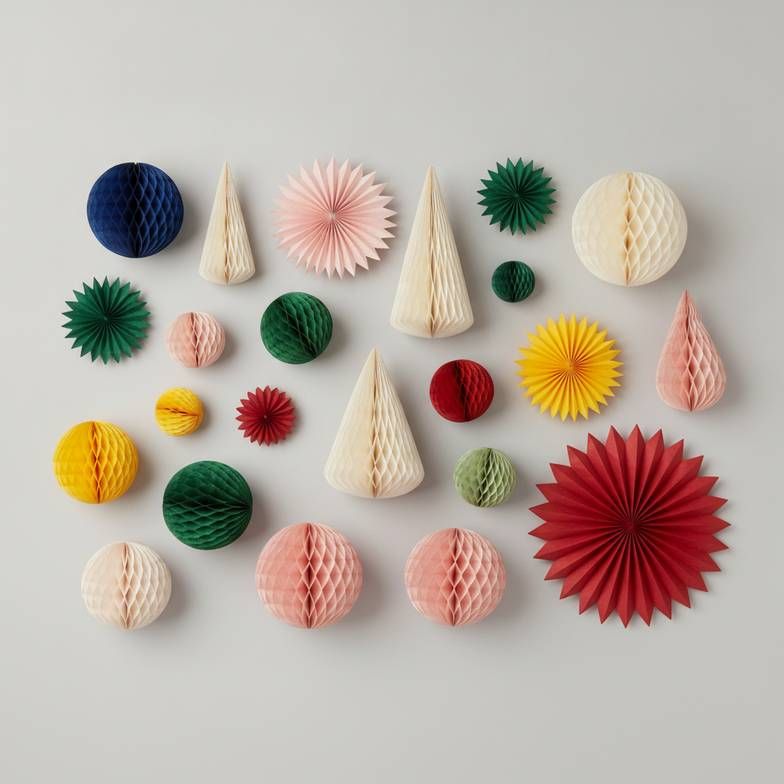
Think of a die-cutting tool as a very strong, very precise industrial cookie cutter made of steel. We create a tool for every single shape we produce. For our standard library of shapes—like spheres, diamonds, fans, and simple trees—these tools have existed for years. Their costs were paid off long ago.
When you request a completely new shape, like your company logo or a custom character for a holiday, we have to engineer and manufacture a brand-new die-cutting tool from scratch. This involves:
- Design & Engineering: Translating your 2D design into a functional 3D honeycomb structure.
- Tool Manufacturing: Crafting the steel rule die itself.
- Testing & Refinement: Running tests to ensure it cuts cleanly and the final product opens correctly.
This process carries a fixed, upfront cost that can be hundreds or even thousands of dollars, depending on the complexity. The MOQ is calculated to spread that cost out. If the tool costs $1,000 to make, it's more feasible to add $1 to the cost of 1,000 units than it is to add $10 to the cost of 100 units.
Assembly Jigs and Labor Training
The tool is only part of the story. Once the paper is cut, our workers need to glue the dozens of layers together with incredible precision. For this, they use assembly jigs—guides that hold the paper in place to ensure every glue line is perfect. A new shape means designing and building new jigs. It also means training our team on how to assemble it efficiently. The first few hundred units of a new design are always slower to produce as the team builds muscle memory.
A higher MOQ ensures that this entire setup and training process is worthwhile.
| Feature | Standard Shapes (e.g., Sphere, Diamond) | Custom Shapes (e.g., Branded Logo, Animal) |
|---|---|---|
| Tooling | Exists, cost is fully amortized | New tooling required (one-time cost) |
| Setup Time | Minimal, experienced workers | Longer, requires new jigs and training |
| Typical MOQ | Lower | Higher |
| Production Speed | Fast and efficient | Slower initially, then ramps up |
From my experience talking to buyers, the best strategy for testing a new collection with a limited budget is often to start with a standard shape. You can still create a completely unique product by focusing on the next factor: color.
Why Does Custom Color Raise the MOQ So Much?
You've found the perfect Pantone shade for your brand's seasonal collection. It's a non-negotiable part of your vision. But when you get the quote, the MOQ is for thousands of pieces, even for a tiny ornament. This is a very common point of confusion, and the answer lies one step up the supply chain.
Your supplier almost certainly does not dye paper in-house. We order colored paper from massive paper mills. Requesting a custom color means the mill must perform a special production run just for you, and their minimum order is often one to two tons of paper.

Dive Deeper: Stock Inventory vs. The Paper Mill's Minimum
In our factory, we keep an extensive inventory of paper in dozens of popular, high-demand colors. I like to think of it as our pantry. When you order a decoration using one of these "stock colors," we can simply pull the required amount of paper and start production. This gives us the flexibility to offer low MOQs.
The Reality of Custom-Dyed Paper
A custom Pantone-matched color is like asking us to source a rare, exotic ingredient that isn't in our pantry. We have to special-order it from our supplier: the paper mill.
Paper mills operate on a massive scale. Their machines are hundreds of feet long. To produce a specific color, they have to:
- Stop production.
- Thoroughly clean the machinery to remove all traces of the previous color.
- Mix a new batch of dye to precisely match your Pantone code.
- Run the paper, a process that yields tons of material at a time.
To make this enormous effort economically viable, they impose a high MOQ on us—usually 1,000 to 2,000 kilograms (about 1-2 tons) of paper per color.
A Real-World Example
I once worked with a client developing a collection of small, 4-inch honeycomb balls in a very specific shade of millennial pink. Each ball only used about 30 grams of paper. However, to get that exact pink, we had to purchase one ton (1,000,000 grams) of paper from the mill.
You can do the math: 1,000,000 grams / 30 grams per ball = ~33,333 balls.
Suddenly, the high MOQ makes sense. It wasn't about the small decoration; it was about the enormous minimum quantity of raw material required to create its unique color. The MOQ for the final product is directly tied to using up that raw material we had to purchase. For buyers, this means a strategic choice:
- Low MOQ Path: Select colors from your manufacturer's stock color book. You can still create a unique aesthetic by combining several stock colors in one collection.
- High MOQ Path: Commit to a custom Pantone color. This is the best option for high-volume orders where brand color consistency is critical and you can meet the volume needed to consume the raw material.
Is Packaging the Hidden Factor in Your Wholesale Honeycomb Paper Decorations MOQ?
You've done everything right. You chose a standard shape and a stock color to keep the MOQ low. Yet, the final number is still higher than you budgeted for. You're left wondering, what did I miss? The answer is often sitting right on the retail shelf: your packaging.
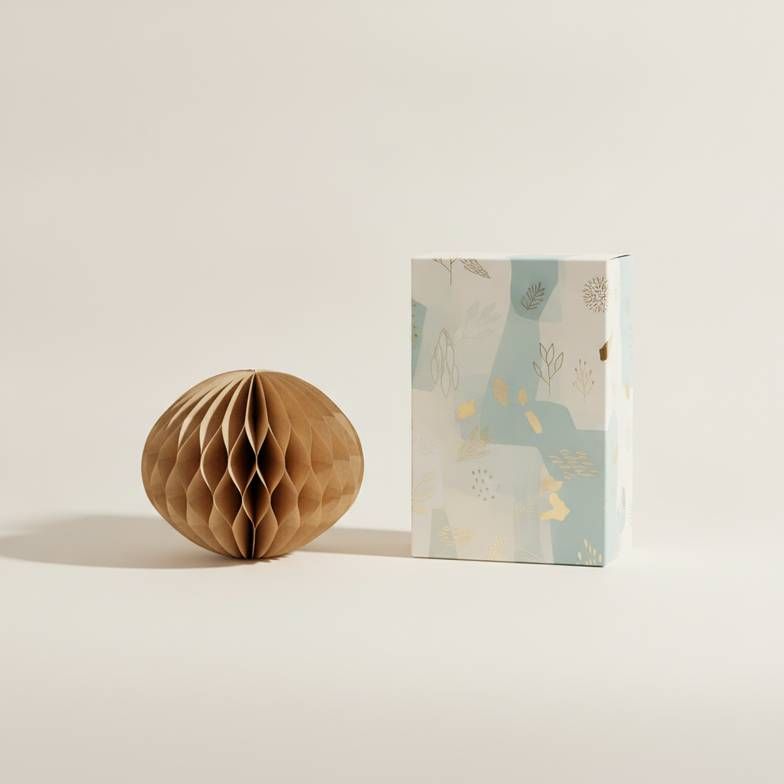
The MOQ for your custom packaging is frequently the real driver of your project's total minimum. We, as product manufacturers, typically outsource printed boxes, sleeves, and insert cards to specialized printing partners, and they have their own separate MOQ for their services.
Dive Deeper: The "Second MOQ" You Didn't See Coming
We are experts in making honeycomb paper decorations, but we are not a printing and packaging factory. For custom retail packaging, we work with trusted partners who specialize in that. These partners have their own production realities.
The Printer's Setup Costs
Just like we have setup costs for a new shape, a printing company has setup costs for a new packaging design. This includes:
- Printing Plates: A unique plate must be created for each color in your design for offset printing.
- Ink Mixing: Matching your brand colors precisely.
- Die-Cutting: Creating a new die to cut the box shape.
To cover these setup costs, a packaging supplier will have their own MOQ, which is often between 1,000 and 3,000 pieces per unique packaging design. This is what I call the "second MOQ."
How This Plays Out in Practice
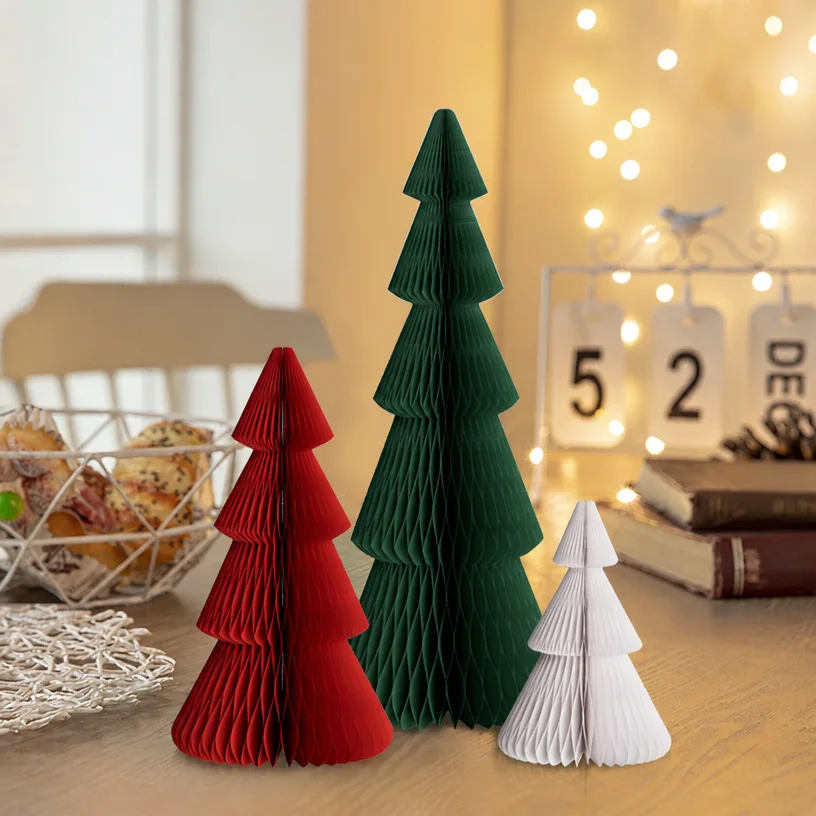
Here’s a scenario I see all the time. A buyer wants to order a holiday collection: 500 green honeycomb trees and 500 red honeycomb balls.
- The shapes are standard.
- The colors are stock.
- The product MOQ is easily met.
But, the buyer wants each item in its own beautifully branded box, one with a green tree design and one with a red ball design. Now, we have to order two different custom boxes from our printing partner. If their MOQ is 1,000 pieces per design, the buyer must either order 1,000 of each product to match the packaging, or we end up with 500 leftover boxes for each design, which isn't feasible. The project's effective MOQ just doubled and is now dictated entirely by the packaging.
Here are your options, from lowest to highest MOQ impact:
- Lowest MOQ: A simple clear polybag. This requires no external supplier.
- Low MOQ: A polybag with a custom-printed sticker. Stickers can be printed digitally with very low minimums.
- Medium MOQ: A custom-printed paper insert card or belly band inside a standard bag or box. The printer's MOQ for the card (e.g., 1,000 units) becomes the driver.
- Highest MOQ: A fully custom-printed, die-cut retail box. This brings the full "second MOQ" into play.
My advice to buyers is always to discuss packaging at the very beginning of the conversation. If you need a low total MOQ, a great strategy is to design a single, attractive packaging solution that can be used across multiple products in your collection.
Frequently Asked Questions
Can I combine different items to meet the MOQ?
This is possible sometimes, but only if the items share key production traits. For example, if you order several different shapes but they all use the same stock-colored paper, they can likely be produced in the same run to meet a raw material minimum. However, a custom-shaped item can't be combined with a standard one to lower a tooling-based MOQ.
What is a reasonable MOQ for wholesale honeycomb paper decorations?
There is no single "reasonable" number. For a standard item using stock colors and simple packaging, an MOQ could be in the hundreds. For a fully custom project involving a new shape, a Pantone-matched color, and a printed retail box, the MOQ could easily be several thousand units. The goal is to understand the manufacturing reasons behind the number.
How does the size of the decoration impact the MOQ?
Size is generally less of a factor than shape, color, or packaging. The primary drivers of MOQ are fixed setup costs. While a larger item uses more paper per piece, this just affects the unit price, not usually the minimum. The exception is for exceptionally large decorations that might require oversized paper or special handling, which could influence the MOQ.
Is the MOQ negotiable?
While the underlying costs of tooling and raw materials are not negotiable, there can be some flexibility in how you meet them. For example, a supplier might offer a lower quantity if you agree to a higher per-unit price to help offset the setup costs. Alternatively, committing to a larger total volume spread over a couple of orders could also open up room for discussion.
Conclusion
Navigating the world of wholesale honeycomb paper decorations becomes much clearer when you understand that MOQ is not an arbitrary barrier, but a logical outcome of the manufacturing process. The three key drivers—shape, color, and packaging—each come with their own set-up costs and supply chain realities. A custom shape requires new tooling. A custom color requires a massive minimum order from a paper mill. And custom packaging introduces a "second MOQ" from a printing partner.
By understanding the trade-offs between standardization and differentiation, you can make informed, strategic decisions. You can now consciously balance your brand's desire for a unique product with the commercial realities of production, ensuring your project is both beautiful and viable. This knowledge transforms you from a simple buyer into a savvy sourcing partner.
Ready to plan your next seasonal collection or retail display? Contact us at Mypaperbloom. Our team is here to help you explore these options and find the perfect balance of custom design and manufacturing efficiency for your wholesale honeycomb paper decorations.