Christmas Decoration Sourcing Timeline: When Should Retail Buyers Start Sampling and Production?
Staring down the retail calendar, do you ever get that nagging feeling that you’re already behind on the holiday season? You know that missing the Christmas merchandising window me
Staring down the retail calendar, do you ever get that nagging feeling that you’re already behind on the holiday season? You know that missing the Christmas merchandising window means lost sales, but the path from a product idea to a stocked shelf is full of potential delays. The solution isn't a magic start date, but a robust Christmas decoration sourcing timeline built by working backward from your launch day.
For retail buyers, the ideal Christmas decoration sourcing timeline starts with confirming product concepts and initial samples in Q1 (January–March). This allows for revisions and packaging design in Q2 (April–June), with the final purchase order confirmed by June or July. Production typically runs through July and August, ensuring goods can ship via sea freight by early September to meet an early November in-store date.
That’s the short answer, but as any experienced merchandiser knows, the reality is much more complex. A simple reorder of a stock design is a world away from a fully custom collection. Let's break down the variables so you can build a timeline that actually works for your specific needs.
How Do You Build a Realistic Christmas Decoration Sourcing Timeline?
It's tempting to take a supplier’s quote of a "60-day production lead time" and think you're all set. But this is one of the most common mistakes new buyers make. That number often ignores the weeks or even months needed for sampling, revisions, packaging development, and shipping. A truly reliable Christmas decoration sourcing timeline accounts for every single step.
The only way to build a reliable schedule is to start with your final deadline—the date products must be on the retail floor—and work backward. You need to add buffer time for each critical stage, from customs clearance and ocean transit all the way back to the very first product brief.

Dive Deeper: Mapping the Critical Path from Store Shelf to Concept
Let's build a typical backward timeline. Our anchor point is an In-Store Launch Date of November 1st. This is when you want your displays up and ready for early holiday shoppers.
- H3: Start with the End in Mind
Everything is calculated from this date. If you need to be on the floor by November 1st, your inventory needs to arrive at your distribution centers (DCs) well before then.
Here's a breakdown of a sample critical path. I’ve seen timelines like this work for hundreds of retail programs.
| Milestone | Target Date | Typical Duration | Key Considerations |
|---|---|---|---|
| In-Store Launch | Nov 1 | — | Your non-negotiable anchor date. |
| Goods at Distribution Center | Oct 15 | 1–2 Weeks | Time for domestic freight and DC check-in. |
| Cleared Customs | Oct 1 | 1–2 Weeks | Varies by port; random inspections can add days. |
| Ship Arrives at Port | Sep 20 | — | Factor in potential port congestion. |
| Sea Freight Transit | Aug 15 – Sep 20 | 4–6 Weeks | This is just ocean time; from China to the US/EU. |
| Production & Final QC Complete | Aug 15 | 45–60 Days | This is the supplier's "lead time." |
| Purchase Order Confirmed | Jun 15 | 1–2 Weeks | PO issued, deposit paid, PPS approved. |
| Pre-Production Sample (PPS) Approved | Jun 1 | 2–3 Weeks | Your final check before mass production. |
| Packaging Design & Sampling Approved | May 15 | 2–4 Weeks | A mini-project within your project. |
| Initial Samples & Revisions Approved | Apr 15 | 3–6 Weeks | Includes color, structure, and material approvals. |
| Project Kick-Off & Supplier Briefing | Mar 1 | — | The true start: sending specs, getting quotes. |
As you can see, a "60-day production time" is just one piece of a 240-day (8-month) puzzle. Starting your planning in March for a November launch is standard. Waiting until summer to begin the conversation is a recipe for expensive air freight and major stress.
What Key Variables Change Your Christmas Decoration Sourcing Timeline?
You've planned everything backward from November 1st, but your supplier just told you a custom color will add a month to the schedule. Why? Because not all products are created equal. The simple Christmas decoration sourcing timeline we mapped out can expand or shrink based on four key variables.
Understanding these factors is crucial for anticipating delays. The main drivers of your timeline are product complexity, color and material choices, packaging requirements, and your total order volume. Each layer of customization adds time, especially during the critical sampling and pre-production phases.
Dive Deeper: Deconstructing the Factors That Add Weeks to Your Schedule
A common question from new buyers is, "I only changed the color, why is it taking so much longer?" What experienced merchandisers know is that every change has a ripple effect. Let's look at the big four.
- H3: Product Design & Structure
- Stock Item: This is the fastest path. If you're ordering an existing design from our catalog in a stock color, the timeline shrinks dramatically. We might only need 1-2 weeks to confirm a quality sample before you place your PO.
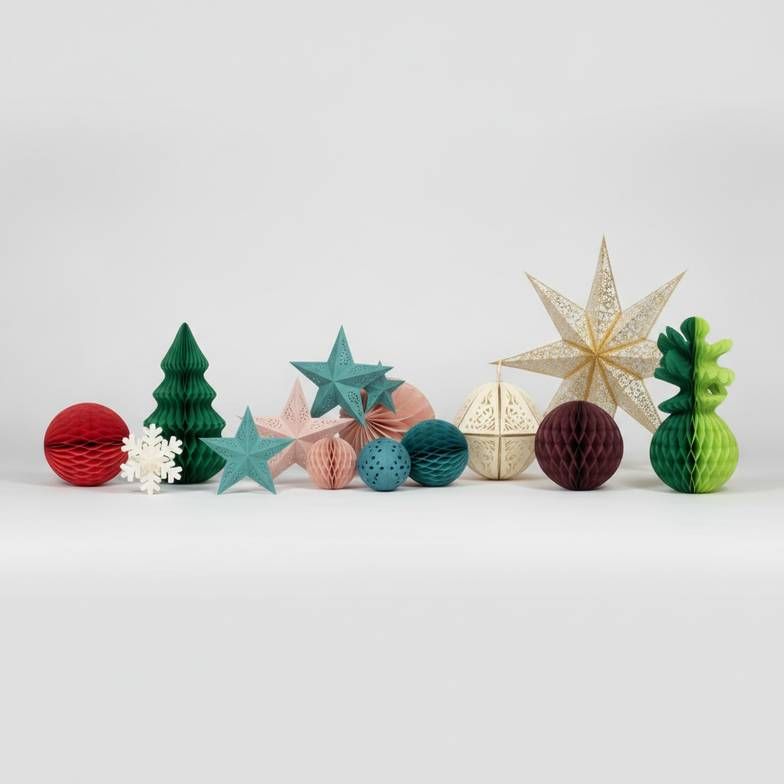
- Modified Item: Let's say you want an existing star design, but 50% larger. This requires a new structural sample. We have to create new cutting dies and test that the larger structure opens properly and maintains its shape. This can add 1-2 weeks to the sampling stage.
- Fully Custom Design: This is the longest path. If you have a completely new concept—like a freestanding paper Christmas tree or a complex geometric shape—we enter a collaborative design and engineering phase. This involves multiple prototypes to test stability, folding mechanisms, and appearance. This stage alone can add 4-6 weeks to your timeline.
- H3: Color & Material Customization
- Stock Colors: We keep a large inventory of paper in our most popular colors. Choosing from this list means we can start sampling and production almost immediately.
- Custom Pantone Colors: This is a major timeline variable. If you need a specific brand color matched, the raw paper has to be custom-dyed at the paper mill. This process requires a significant minimum order quantity (MOQ) and adds 3-4 weeks to the schedule before we can even begin making your decorations. You'll need to approve "lab dips" (small swatches of dyed paper) first, which also takes time.
- H3: Packaging Complexity
- Bulk Wholesale Pack: This is simple and fast. Products are packed efficiently into master cartons for easy shipping.
- Custom Retail Packaging: A retail-ready box with a window, a printed hangtag with a barcode, or an instruction sheet are all timeline extenders. This is essentially a separate manufacturing project. It involves graphic design, creating a structural die-line, printing proofs, and getting your approval. This process can easily add 2-4 weeks to the pre-production schedule.
- H3: Order Volume and Peak Season Capacity
The holiday rush is real for manufacturers, too. Our production capacity is finite, and the peak season for Christmas decoration manufacturing runs from roughly July to September. An order confirmed in May gets a scheduled production slot. An order confirmed in late July might have to wait in a queue, pushing its completion date into September and threatening your sea freight window. Large orders naturally require longer production runs and must be booked further in advance.
How Can Buyers Mitigate Risks in Their Christmas Decoration Sourcing Timeline?
So you’ve built a detailed plan, but you're still worried about a typhoon delaying your shipment or a quality issue popping up at the last minute. These are valid concerns. The final step is to treat your Christmas decoration sourcing timeline not just as a schedule, but as a risk management framework.
The best way to protect your timeline is to front-load major decisions, build in buffer days at critical points, and maintain clear communication with your supplier. Don't view approving samples as a chore to be rushed; see it as your most important risk-mitigation tool to ensure what you receive is exactly what you ordered.

Dive Deeper: Proactive Steps to Safeguard Your Holiday Launch
Here at Mypaperbloom, we’ve helped clients navigate these risks for years. The most successful programs are always the ones where the buyer is proactive and asks the right questions from the very beginning.
- H3: Front-Load Your Biggest Decisions
The decisions with the longest lead times—custom structures and custom Pantone colors—must be made first. Don't wait until May to debate a specific shade of green. Lock in these foundational elements in March or April. This clears the biggest potential roadblocks early and allows the rest of the process to flow smoothly.
- H3: Build in a Buffer (Especially for Shipping)
Your timeline is not complete without a buffer. Murphy's Law loves international logistics.
- Shipping Buffer: Add at least two extra weeks to your shipping timeline. Ports get congested. Shipments get selected for random customs inspections. Weather can delay vessels. This buffer is your best defense against events you can't control.
- Production Buffer: Add an extra week for sample revisions or minor production adjustments. It’s far better to have this time and not need it than to be scrambling at the last minute.
- H3: Ask Your Supplier the Right Questions
An experienced supplier should be able to answer these questions easily. Their answers will help you build a much more accurate timeline.
- What is your production capacity during peak season (July–September)?
- What are your cutoff dates for PO confirmation to guarantee a spot for pre-Christmas sea freight?
- What is the specific lead time and MOQ for a custom-dyed paper color?
- What are all the approval stages for my project (e.g., color lab dip, structural sample, pre-production sample)?
- What is the lead time for producing my custom retail packaging once the design is approved?
- Can you provide a detailed backward timeline based on my target in-store date of November 1st?
- H3: Communicate Decisively and Proactively
Your supplier's timeline depends on your feedback. A one-week delay on your end to approve a sample can cause a two-week delay on our end if we miss a scheduled production slot. Be prompt, be clear with your feedback, and keep your manufacturing partner in the loop about your key deadlines.
Frequently Asked Questions
When is it officially "too late" to source Christmas decorations for this year?
Generally, if you haven't confirmed an order for sea freight by late August or early September, you've likely missed the window for a timely holiday delivery. Air freight is an extremely expensive alternative, but even that requires production to be complete by mid-October at the latest.
How much buffer time should I add to my sourcing timeline?
A safe strategy is to build in 3-4 weeks of total buffer time. We recommend allocating at least two weeks specifically for the shipping and customs phase, as this is where the most unpredictable delays occur. Spreading another 1-2 weeks across sampling and production provides a cushion for revisions.
Does reordering an existing product have a shorter timeline?
Yes, a reorder significantly shortens the timeline. It bypasses the lengthy design, prototyping, and custom sampling stages. You may only need to approve a quick pre-production sample from the new batch. This can cut 4-8 weeks from the total process, allowing you to place reorders much later in the season.
Is air freight a viable option if I'm behind schedule?
Air freight should be treated as an emergency last resort, not a planned strategy. While it cuts transit time from weeks to days, the cost can be 5-10 times higher than sea freight. For relatively lightweight but bulky products like paper decorations, this expense can easily erase your entire profit margin.
Conclusion
Ultimately, a successful Christmas decoration sourcing timeline is not about finding a magic "start date" on the calendar. It's a strategic process that begins with your end goal—your in-store launch—and works backward. By identifying the variables that apply to your specific project, from custom colors to retail packaging, you can transform a vague schedule into a predictable, risk-managed plan. The most important step you can take is to communicate clearly with your manufacturing partner and ask the detailed questions that reveal the true critical path. This proactive approach is the best way to ensure your beautiful holiday decorations arrive on time and on budget, ready for a profitable season.
Ready to plan your next seasonal collection? Contact us at Mypaperbloom to discuss your product ideas. We can help you build a realistic Christmas decoration sourcing timeline tailored to your retail launch.