Valentine’s Day Paper Decorations for Retail: Display and Assortment Ideas
Sourcing for a seasonal rush like Valentine's Day can feel like a mad dash. You need to find products that will stop customers in their tracks, but the logistical challenges of a m
Sourcing for a seasonal rush like Valentine's Day can feel like a mad dash. You need to find products that will stop customers in their tracks, but the logistical challenges of a multi-store rollout are a constant worry. The best Valentine’s Day paper decorations for retail are those that balance stunning visuals with practical, real-world efficiency.
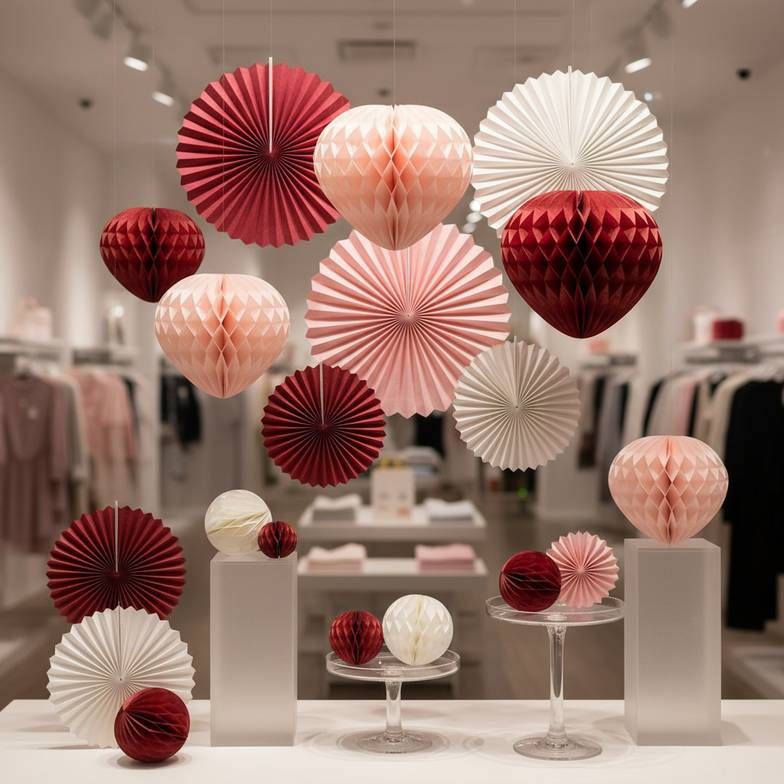
The most effective display and assortment ideas for Valentine's Day paper decorations for retail involve building a coordinated collection rather than hunting for single hero items. This strategy means mixing large-scale hanging pieces for windows with smaller tabletop items and garlands for in-store zones, all unified by a consistent color palette to ensure visual impact while streamlining supply chain logistics.
Thinking in terms of a "collection" instead of just "decorations" is a game-changer. It shifts the goal from finding one perfect item to building a complete, easy-to-execute visual merchandising story. Let's dive into how you can plan an assortment that looks great and works even better.
How Do You Create a Balanced Retail Assortment?
You’ve found a gorgeous, large-scale paper heart that would be perfect for your store window. But now what? It's easy to get stuck here, or worse, to start adding unrelated items that create a disjointed theme that’s a headache for store teams to merchandise properly.
A balanced assortment is built by choosing a "hero" product to grab attention and then supporting it with "helper" and "connector" decorations. By keeping all these pieces within a defined color palette, you create a cohesive and scalable theme.
Dive Deeper: The Hero, Helper, and Connector Method
When we work with retail buyers to plan a seasonal program, we often recommend thinking about the role each decoration will play. This simple framework helps ensure you cover all your bases, from the front window to the cash wrap.
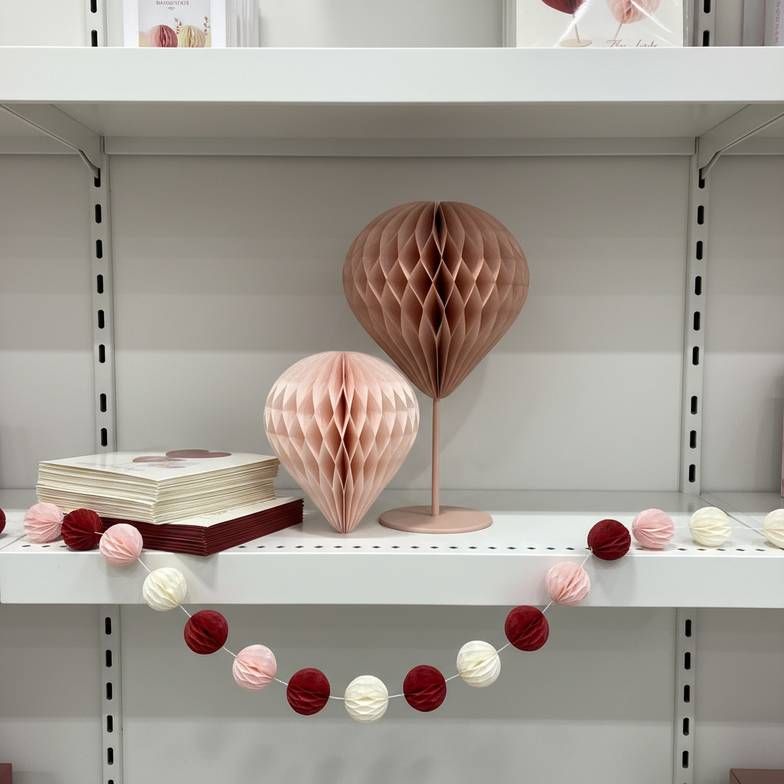
- The Hero: This is your big, attention-grabbing piece. Think large honeycomb hearts, oversized 3D paper sculptures, or dramatic hanging fans. Its primary job is to be seen from a distance, drawing customers in from the street or the mall corridor. These are typically placed in main windows, at entrances, or in high-ceiling atriums. When sourcing a hero piece, the most important logistical question is: What are its folded dimensions for shipping? A five-foot-wide decoration needs to be incredibly compact to be cost-effective.
- The Helper: These are your medium-to-small tabletop and shelf-level decorations. This category includes smaller honeycomb balls, standing paper hearts, and mini ornaments. Their purpose is to carry the theme throughout the store, adding color and texture to product displays, shelving units, and point-of-sale areas. For helper pieces, the key considerations are stability and footprint. Will they stand up on their own without tipping over? Do they take up too much valuable merchandising space?
- The Connector: These are the linear elements that tie everything together. Paper garlands, honeycomb streamers, and hanging paper chains are perfect examples. Connectors guide the customer's eye through the space, define different promotional zones, and add layers to the overall design. Logistically, you need to consider their length and ease of hanging. A good connector is lightweight and has a simple, secure loop or string for quick installation.
Here’s a simple table to illustrate the concept:
| Format Type | Primary Role | Typical Placement | Key Sourcing Consideration |
|---|---|---|---|
| Hero (Large Hanging) | Attract Attention | Windows, Atriums, Entrances | Folded dimensions for shipping & handling |
| Helper (Tabletop) | Add Detail & Depth | Shelves, Tables, POS | Stability, footprint, and durability |
| Connector (Garlands) | Guide & Unify | Walls, Aisles, Ceilings | Length, weight, and installation method |
By consciously selecting items from each category, you build a robust and visually interesting assortment that feels intentional and complete.
What Makes Valentine’s Day Paper Decorations for Retail Logistically Sound?
That intricate paper sculpture looks amazing in the supplier's catalog, but is it going to arrive as a tangled mess that frustrates your store teams? A common pain point we hear from visual merchandising coordinators is the hidden labor cost of difficult-to-assemble decorations.
Logistically sound Valentine’s Day paper decorations for retail are defined by three things: they are compact for shipping, intuitive for anyone to assemble, and durable enough to look good for the entire promotional period.

Dive Deeper: Evaluating the Full Product Lifecycle
From the factory to your storeroom floor, every decoration has a life cycle. A smart buyer evaluates a product based on this entire journey, not just the final look.
From Flat-Pack to Full Display: The Assembly Test
This is where many programs succeed or fail. The beauty of honeycomb paper decorations is their ability to ship flat and expand into a full 3D shape. However, how they open and close is critical.
- Magnetic vs. Adhesive Closures: Many lower-cost decorations use a strip of double-sided tape for closure. While functional, it's a one-time use solution. Once stuck, you can't easily flatten it for storage without tearing the paper. It can also be tricky for staff to align perfectly. In contrast, decorations with small, embedded magnets are a game-changer for retail rollouts. They snap together perfectly every time, can be opened and closed repeatedly, and allow for the decorations to be packed away and potentially reused. A common question we get from sourcing teams is about assembly speed, and magnets are always the winner.
- Instructions and Intuition: A good decoration shouldn't require a complex manual. Ask your supplier for assembly instructions or, even better, a sample you can test yourself. Can you figure it out in under 30 seconds? If not, multiply that confusion by the number of stores and employees you have—it adds up to a lot of wasted time.
Shipping, Storage, and Distribution Efficiency
Before you approve a purchase order, you need the numbers. Specifically, the carton specs.
- Folded Dimensions: Ask for the dimensions of the product in its folded, flat-packed state. A 3-foot honeycomb heart that folds down to less than an inch thick is a logistical dream.
- Carton Dimensions & Weight: How many units come per master carton? What are the carton's dimensions and gross weight? Your logistics team needs this information to calculate freight costs and warehouse space.
- Pre-Packed Kits: A great manufacturing partner can often pre-pack assortments into "store kits." Instead of sending you a pallet of hearts and a pallet of garlands, they can create single cartons containing the exact mix of decorations needed for one store. This dramatically reduces handling and distribution costs at your own warehouse. When our clients plan for multi-store rollouts, this is one of the most valuable services we can offer.
When Should You Customize Valentine’s Day Paper Decorations for Retail?
You want a look that's unique to your brand, but the idea of high MOQs and long development timelines for a fully custom product seems risky for a short season. Is it possible to create a signature look without starting from scratch?
The most strategic way to approach customization for seasonal programs is to modify existing, proven decoration structures with your brand's specific color palette. This gives you a unique look while minimizing the risks, costs, and lead times associated with developing a new product.
Dive Deeper: Smart Customization for Seasonal Success
The request for "something custom" is one we hear daily. However, "custom" can mean many things, and understanding the difference is key to a successful project.
The Two Paths: Custom Shape vs. Custom Color
- Custom Shape: This involves creating an entirely new decoration structure that doesn't exist in the supplier's catalog. It requires designing and producing new cutting dies and assembly jigs. This path almost always involves significant tooling costs, very high minimum order quantities (MOQs), and a much longer development timeline for sampling and testing. For a short season like Valentine's Day, this is often not a practical or cost-effective approach unless it's part of a multi-year strategy.
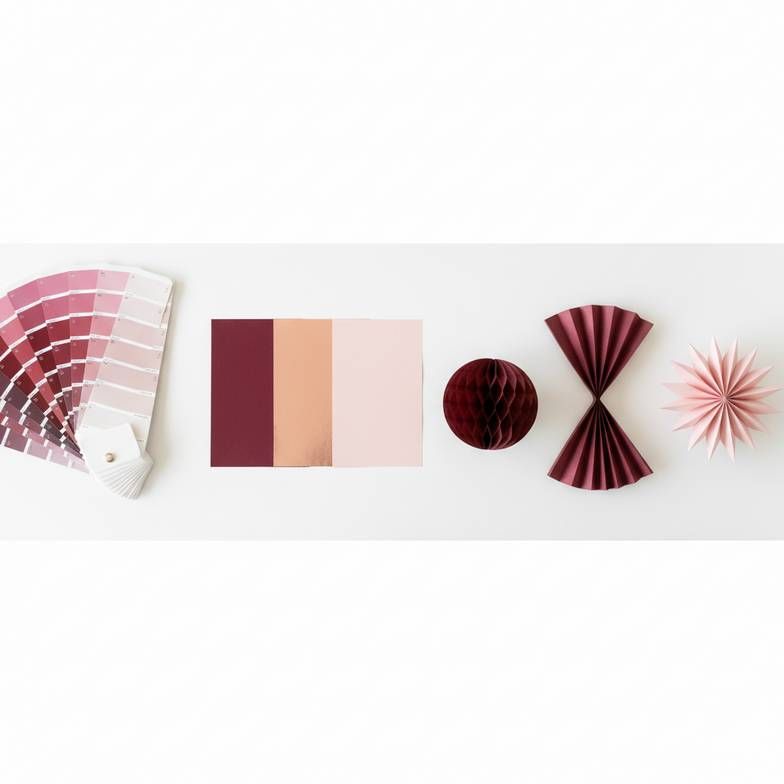
- Custom Color: This is the smarter path for most seasonal retail programs. You select from your supplier's existing catalog of proven shapes—hearts, balls, fans, diamonds, etc.—and ask them to produce it in your custom brand colors. Since the tooling already exists, you bypass the development costs. While the MOQ for a custom color run will be higher than for a standard stock color, it is far more accessible. This approach gives you a unique, on-brand look with predictable results and a manageable timeline. I've seen clients achieve fantastic results by simply moving away from the standard red and pink to a more sophisticated palette of blush, burgundy, and gold.
Aligning Your Calendar with Production Realities
The single biggest mistake buyers make with seasonal sourcing is starting too late, especially when customization is involved. The production and shipping timeline is longer than most people think.
Here is a general timeline you should plan for, working backward from your in-store date:
- August/September (6 months out): Finalize your assortment strategy and custom color palette. This is the time to negotiate with your supplier and lock in your product selection.
- October (5 months out): Receive and approve pre-production samples. This is your last chance to check color, construction, and packaging before the full order goes into production.
- November/December (4-3 months out): Mass production is underway at the factory.
- Late December/Early January (2 months out): Your order ships from the port of origin. Ocean freight takes time.
- February (1 month out): Goods arrive at your distribution center, ready to be allocated and shipped to individual stores.
Waiting until Q4 to start sourcing your Valentine’s Day paper decorations for retail leaves you with only off-the-shelf options and a high risk of stockouts.
Frequently Asked Questions
How far in advance should I order seasonal paper decorations?
For any custom elements like color, you should be finalizing orders 6-8 months before your in-store date. For standard, off-the-shelf items, 4-5 months is a safer window. This accounts for production, shipping, customs clearance, and domestic distribution.
What's the difference between magnet and adhesive closures on paper decorations?
Magnet closures use small, embedded magnets that snap together for a clean, secure hold. They are fast to assemble and allow the decoration to be collapsed and reused. Adhesive closures use a strip of double-sided tape, which is a permanent, one-time-use solution that can be slower to assemble and risks tearing the paper upon disassembly.
Can I get a completely custom-shaped paper decoration for my brand?
Yes, this is possible, but it is considered a full OEM project. It requires new tooling, has a much higher MOQ, and involves a longer lead time for development and sampling. For short seasonal campaigns, customizing the color of an existing shape is often a more practical and cost-effective strategy.
How do I ensure color consistency across a large order of decorations?
Work with a supplier who has a clear quality control process. You should always request and sign off on a pre-production sample that will serve as the standard. Ask your supplier how they control for color variation between different production batches.
Conclusion
Sourcing effective Valentine’s Day paper decorations for retail is a strategic exercise, not just a shopping trip. By shifting your focus from individual items to a balanced assortment, you can create a powerful visual story. The key is to evaluate each product through a logistical lens—prioritizing ease of assembly, shipping efficiency, and smart customization. By planning your hero, helper, and connector pieces and aligning your calendar with production realities, you set your retail program up for a smooth, consistent, and profitable season. A well-planned collection not only looks beautiful but also respects the time and effort of your logistics and store operations teams.
If you're planning your next seasonal program, our team is here to help you develop a coordinated collection of Valentine’s Day paper decorations for retail that meets both your visual and logistical requirements. Contact us to discuss your assortment ideas and see how we can streamline your sourcing process.