Retail-Ready Packaging for Honeycomb Decorations: A Guide for Private Label Buyers
Choosing the right packaging for your product line can feel overwhelming. When it comes to finding the perfect retail-ready packaging for honeycomb decorations, the sheer number of
Choosing the right packaging for your product line can feel overwhelming. When it comes to finding the perfect retail-ready packaging for honeycomb decorations, the sheer number of options can be paralyzing. Make the wrong choice, and you risk damaged products, poor on-shelf presence, and hidden costs that eat into your margins. But what if you could turn packaging from a line-item cost into a strategic asset that protects your product and boosts sales?
The best retail-ready packaging for honeycomb decorations isn't a single option, but a strategic choice that balances four key factors: your primary sales channel, your brand identity, shipping and handling realities, and your budget. The optimal solution for an e-commerce brand will be different from that of a premium department store, focusing on the total value packaging adds, not just the per-unit cost.
Now that you know there's no magic bullet, how do you make the right choice for your business? It starts by asking better questions. Instead of just looking for a "good box," you need to define what your packaging needs to do. Let's break down the exact factors you should be evaluating.
What Does 'Retail-Ready' Actually Mean for Your Sales Channel?
The term "retail-ready" often causes confusion. Does it mean the product can survive a courier's van, or that it looks great on a shelf? The truth is, it means both, but the emphasis changes dramatically depending on where you sell.
Defining "retail-ready" for your specific sales channel is the first and most important step. A common mistake we see is clients choosing beautiful but flimsy boxes that get crushed in e-commerce fulfillment centers, or sturdy but plain packaging that gets lost on a crowded retail shelf.

Dive Deeper: Aligning Packaging with Your Point of Sale
The journey your product takes to the customer dictates its packaging needs. The demands of an automated warehouse and a courier network are completely different from those of a brick-and-mortar store. From our experience, buyers who define their primary sales channel first make far better packaging decisions.
E-commerce "Retail-Ready" Packaging
For products sold primarily online, whether through your own site, Amazon, or another marketplace, the key priorities are durability and the unboxing experience.
- Protection is Paramount: Your package will be handled multiple times, dropped, sorted by machines, and packed alongside other items. It needs to withstand the journey without getting crushed, bent, or torn. The delicate, folded edges of honeycomb paper are particularly vulnerable.
- The Unboxing Experience: Since the customer can't see or touch the product before buying, the unboxing is their first physical interaction with your brand. Does the packaging feel cheap or thoughtful? Is it easy to open? This moment can be the difference between a one-time sale and a loyal customer. In my early days, I saw a client save a few cents per unit on thin polybags, only to face a spike in returns and negative reviews citing "damaged upon arrival."
- Compact & Lightweight: Shipping costs are calculated by dimensional weight. Efficient, minimal packaging can save you a significant amount on logistics, especially for an international supply chain.
Physical Retail "Retail-Ready" Packaging
For products sold in physical stores, from small boutiques to large department stores, the focus shifts to visibility and merchandising.
- Visual Appeal & Information: The package is your silent salesperson. It needs to grab attention, clearly show the product inside (or a high-quality image of it), and communicate value. A window box is a classic solution here, as it allows customers to see the decoration's true color and texture.
- Merchandising Functionality: Can the package hang on a peg hook? Can it be stacked securely on a shelf? Does it have a scannable barcode in an accessible location? These practical details are non-negotiable for most retailers.
- Brand Consistency: In a store, your product sits next to competitors. The packaging must instantly communicate your brand identity and feel cohesive with the rest of your collection.
| Feature | E-commerce Priority | Physical Retail Priority |
|---|---|---|
| Primary Goal | Survive shipping & impress at home | Attract attention & inform on shelf |
| Key Attribute | Structural Durability | Visual Appeal |
| Customer Interaction | The "Unboxing Experience" | The "Shelf-Shopping Experience" |
| Ideal Format | Sturdy mailer box, reinforced polybag | Window box, printed color box, hang-sell card |
| Failure Mode | Product arrives damaged | Product is ignored by shoppers |
How Should You Balance Cost Against Total Product Value?
Every private label buyer is focused on cost—and for good reason. But a common pitfall is focusing solely on the per-unit price of the packaging itself. This ignores the hidden costs of a poor packaging choice, which can often outweigh any initial savings.
The smarter approach is to evaluate packaging based on its Total Cost of Ownership (TCO). This means looking beyond the supplier's quote and considering the financial impact of your packaging across the entire product lifecycle, from factory to customer.

Dive Deeper: The True Cost of Your Packaging Decision
We often get the question, "What's your cheapest box?" But a more strategic question is, "Which packaging option delivers the best value by protecting my product and supporting my sales goals?" Let's look at what goes into that "total cost."
- Cost of Damage and Returns: Let's say you save $0.10 per unit by choosing a flimsy polybag over a sturdier cardboard sleeve for your 12-inch honeycomb balls. If just 2% of your shipment gets crushed during transit and results in customer returns, the cost of reverse logistics, replacement product, and lost customer goodwill will wipe out those savings almost instantly. Investing a little more in protective retail-ready packaging for honeycomb decorations is an insurance policy against these losses.
- Cost of Lost Sales: In a physical retail setting, poor packaging directly translates to lost sales. If your product is in an opaque box and the one next to it is in a clear window box, which one do you think a customer is more likely to pick up? If your packaging can't be stacked and keeps falling over, retailers will be less likely to give it premium shelf space. The "cost" here is the missed revenue opportunity.
- Logistical Costs: As mentioned earlier, size and weight matter. Sometimes, a slightly more expensive but lighter material or a more compact design can lead to significant savings on sea freight, air freight, and last-mile delivery. We work with clients to optimize carton sizes to maximize container space, a step that directly impacts the final landed cost of each decoration.
- Brand Perception Cost: Packaging signals quality. A premium honeycomb decoration presented in a cheap, crinkly bag sends a mixed message to the consumer. This mismatch can devalue your brand and make it harder to justify a premium price point. Your packaging should feel like it's part of the product, not a disposable afterthought.
Ultimately, you should treat your packaging budget as an investment in product integrity and marketing, not just a necessary expense.
Which Packaging Style Best Solves Your Commercial Problems?
Once you've defined your channel and cost philosophy, you can start exploring specific packaging formats. Instead of thinking in terms of a simple list—polybag, color box, PVC box—it's more effective to frame each type as a solution to a specific set of commercial and logistical problems.
Choosing the right style is about matching the packaging's strengths to your product's needs and your brand's story. Are you a high-volume, budget-focused online brand or a curated, premium boutique collection? The answer will guide your choice.

Dive Deeper: Matching Packaging Formats to Your Strategy
Here's how we advise clients to think about the most common options for retail-ready packaging for honeycomb decorations.
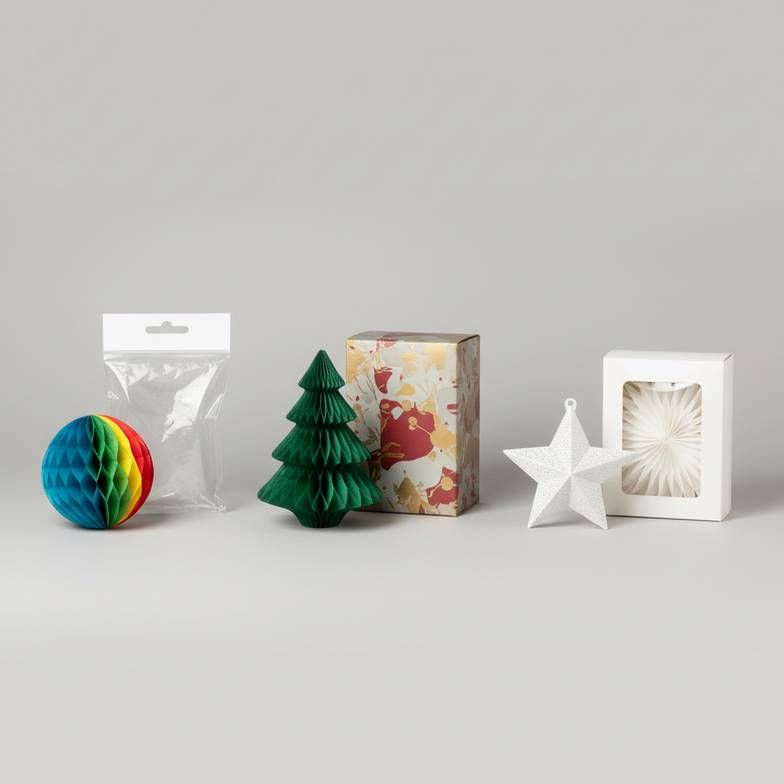
The Polybag with Header Card Solution
This is often the most cost-effective option. It consists of a clear polypropylene bag that protects the decoration from dust and moisture, topped with a printed cardboard header that provides branding, product information, and a hang-hole for retail displays.
- Best for: Budget-conscious brands, online sellers (as a primary wrap inside a shipper box), and high-volume seasonal programs where cost-per-unit is critical.
- Pros: Lowest cost, lightweight, allows customers to see the product's color.
- Cons: Offers minimal protection against crushing or bending. Can look less premium than a box. The thin plastic can sometimes feel cheap to the end consumer.
The Printed Color Box Solution
A fully enclosed, custom-printed cardboard box. This option turns the entire package into a canvas for your brand story, with high-quality graphics and text.
- Best for: Brands with a strong visual identity, e-commerce products where the unboxing experience is key, and giftable items.
- Pros: Excellent branding opportunities, offers good structural protection, can be designed to stack well.
- Cons: The customer cannot see the actual product, so high-quality photography on the box is essential. Higher cost than a polybag.
The Window Box Solution
This is a hybrid approach, combining the protection and branding of a color box with a clear PVC or PET window that reveals the product inside.
- Best for: Physical retail environments where product visibility is paramount. It allows customers to see the exact color and texture of the honeycomb paper, reducing hesitation and increasing purchase intent.
- Pros: The "best of both worlds"—combines protection, branding, and product visibility. Perceived as higher value.
- Cons: Generally the most expensive option due to the multi-material construction and assembly process. The plastic window also raises environmental considerations for some brands and markets.
How Can You Communicate Your Packaging Needs Clearly to a Supplier?
The final step is to translate your strategic decisions into a clear and actionable brief for your manufacturing partner. Vague requests are the primary source of delays and disappointing samples. We've seen it all.
The difference between getting the perfect package on the first try and going through three rounds of frustrating revisions often comes down to the quality of the initial request. A supplier can't read your mind; you have to be explicit about what you need the packaging to achieve.

Dive Deeper: From Vague Request to Actionable Brief
Instead of asking, "Can you give me a good box for this honeycomb ball?", you will get a much better result by providing a detailed brief. Think of it as a spec sheet for your packaging. A great brief moves the conversation from guesswork to engineering.
A weak request looks like this: > "We need retail packaging for a 12-inch honeycomb ball. Please provide options and pricing."
This forces the supplier to guess your channel, your brand positioning, and your quality standards.
A strong request looks like this: > "We are developing retail-ready packaging for a 12-inch honeycomb decoration for our private label brand, which will be sold in US department stores. > > Here are our requirements: > 1. Sales Channel: Physical retail shelves. The package must be able to stand on its own and also have a reinforced hang-hole. > 2. Product Visibility: We need a large, clear window so customers can see the product's color and honeycomb structure. The window must be scratch-resistant. > 3. Protection: The box must protect the decoration's delicate edges from being crushed when stacked up to 5 units high in a warehouse. > 4. Branding: The box should be made from 350gsm C1S art paper with a matte lamination finish. We will provide the print-ready artwork (CMYK). > 5. Information: Please leave a 3x5 cm space on the back for a barcode and product information sticker. > 6. Unboxing: The box should be easy for a customer to open without tearing."
This level of detail allows a supplier to provide an accurate quote for a package that meets your specific commercial needs. It eliminates ambiguity and speeds up the entire development process.
Frequently Asked Questions
How much does custom packaging add to the product cost?
The cost varies widely based on material, structure, print finish, and quantity. A simple polybag with a header might add a few cents, while a complex, rigid window box with foil stamping could add a dollar or more. It's best to request quotes for 2-3 different options to compare.
What is the typical MOQ for custom retail packaging?
Minimum Order Quantities for custom packaging are often driven by the print runs of the packaging supplier. For printed boxes, MOQs typically start around 1,000 to 2,000 pieces per design. Simpler formats like header cards may have lower thresholds. Always confirm this with your manufacturing partner.
Should the packaging always show the product's true color?
For physical retail, it's highly recommended. Customers want to see what they are buying, especially with color-sensitive products like decorations. This is why window boxes are so popular. For e-commerce, it's less critical, as customers rely on the online photos, but the unboxing reveal is still powerful.
How can I test my packaging for durability?
You can request pre-production samples and perform your own "shake and drop" tests. For e-commerce, a good practice is to ship a packaged sample to yourself through a standard courier network. This simulates the real-world journey and is the best way to identify potential weak points before you commit to a bulk order.
Conclusion
Choosing the right retail-ready packaging for honeycomb decorations is a critical strategic decision, not an afterthought. It requires you to move beyond simply asking for the "cheapest box" and instead define what you need your packaging to accomplish for your specific brand and sales channel. By focusing on the total value—balancing protection, branding, logistics, and the customer experience—you create a packaging solution that does more than just hold a product. It protects your investment, represents your brand on the shelf, and ultimately helps drive sales.
If you are developing a private label collection and need guidance on finding the perfect packaging solution, our team has the experience to help you navigate these choices. Contact us to discuss your project requirements, and let's create packaging that works as hard as your products do.