How to Plan a Multi-Store Seasonal Display Rollout with Foldable Paper Decorations
Struggling to get your vision for a seasonal campaign to look the same in all 100 of your stores? The complexity of a large-scale deployment can be overwhelming, where a single mis

Struggling to get your vision for a seasonal campaign to look the same in all 100 of your stores? The complexity of a large-scale deployment can be overwhelming, where a single misstep in planning can lead to inconsistent branding and frustrated store staff. A successful multi-store seasonal display rollout isn't about finding one perfect decoration; it's about building a systematic plan that prioritizes logistics and execution from day one.
To plan a multi-store seasonal display rollout, you must shift your focus from individual products to a complete “rollout kit” for each store. Define this kit first, then prioritize logistics like folded dimensions and master carton efficiency. Design the display for simple, fool-proof assembly by non-experts, and finally, vet suppliers based on their ability to manage complex kitting and shipping logistics, not just their product catalog.
That might sound like putting the cart before the horse, but I promise it's the secret to a smooth, consistent, and cost-effective campaign. Let's break down this systematic approach to help you manage the complexity and avoid the predictable failures I’ve seen so many times.
Why Should You Define the 'Rollout Kit' Before Choosing Decorations?
You’ve found it—the perfect, show-stopping paper ornament. But if you try to scale it across 200 stores without thinking about the bigger picture, you might find that shipping costs balloon and assembly becomes a nightmare. The solution is to think about the system before the individual parts.
Your focus should be on defining the "rollout kit" first—the complete, self-contained package that will be sent to a single store. This kit includes the decorations, any required mounting hardware, and, most importantly, clear instructions. This definition drives all your subsequent logistical and financial decisions.

Dive Deeper: The Shift from Product to System
The most common mistake I see brands make is evaluating decorations in isolation. They fall in love with an aesthetic without considering the operational reality of deploying it at scale. A successful multi-store seasonal display rollout demands a mindset shift from "What decorations should we buy?" to "What should our all-in-one store kit contain?"
A typical rollout kit might include:
- A specific assortment of foldable paper decorations (e.g., 3 large honeycomb balls, 5 small fans).
- A one-page, highly visual instruction sheet (more on this later).
- Pre-cut hanging line or hooks.
- Any required clips or fasteners.
The first question I ask a client planning a rollout is, "What does one store's box look like?" Once we define that, everything else falls into place. This "kit-first" approach forces you to confront the logistical challenges early on, when you still have time to make smart, cost-effective choices.
How Logistics Should Drive Product Selection
For a multi-store rollout, logistical properties are often more critical than aesthetic ones. The beauty of foldable paper decorations is their incredible shipping efficiency, but you have to plan for it.
Think about these factors:
- Folded vs. Open Dimensions: A 30-inch decoration is impressive, but how small does it fold? The folded size dictates your packaging, shipping costs, and the storage space needed in a crowded stockroom.
- Weight: Paper is light, but when you multiply a few ounces by thousands of units, the total weight can significantly impact freight costs.
- Master Carton Efficiency: How many individual store kits can fit into one master carton? How many of those cartons fit on a standard pallet? A supplier experienced in rollouts can provide these numbers, which are crucial for budgeting your shipping.
Here’s a quick comparison of two hypothetical decorations to show you what I mean.
| Feature | Decoration A (Visually Complex) | Decoration B (Logistically Smart) |
|---|---|---|
| Open Size | 24 inches | 22 inches |
| Visual Impact | High | High |
| Folded Dimensions | 12" x 6" x 2" | 11" x 5.5" x 0.5" |
| Individual Weight | 8 oz | 5 oz |
| Kits per Master Carton | 50 | 120 |
| Master Cartons/Pallet | 12 | 20 |
| Rollout Implication | Higher shipping cost per store, more storage space needed, less efficient. | Lower shipping cost per store, less storage space, highly efficient. |
As you can see, Decoration B delivers nearly the same visual impact but is far superior for a large-scale rollout due to its logistical efficiency. Focusing on the kit and its shipping properties from the start will save you enormous amounts of time, money, and stress.
How Can You Guarantee Easy In-Store Execution of Your Seasonal Display Rollout?
Your beautifully planned kits have arrived at all 500 stores. But the display in Boston looks nothing like the one in San Diego because the staff were confused, busy, and lacked the right tools. Your entire investment in brand consistency is now at risk.
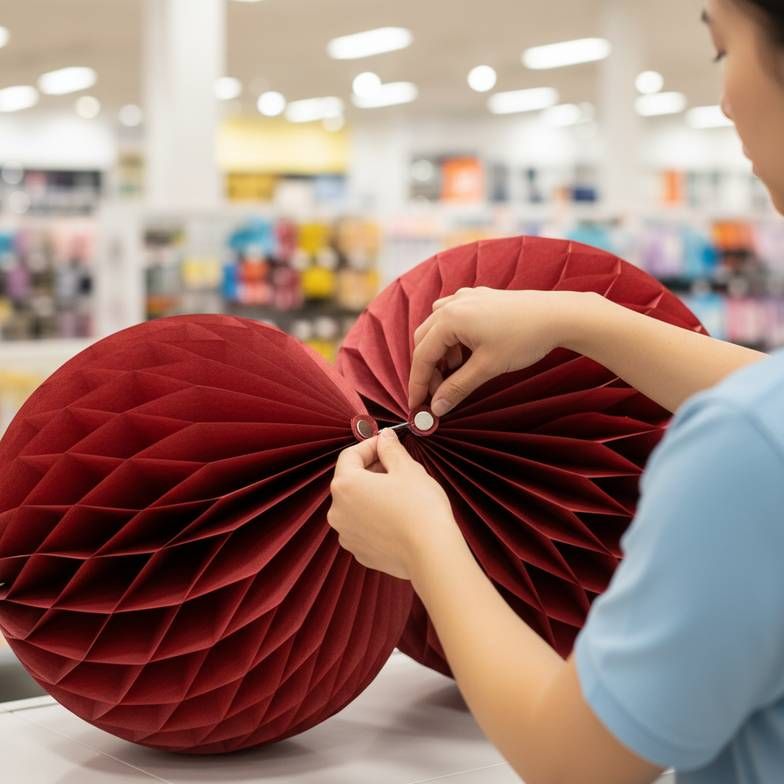
You must assume that your in-store teams have minimal time and zero training on visual merchandising. Your multi-store seasonal display rollout plan has to be built for simplicity at the point of installation. This means idiot-proof instructions, easy-to-use mechanisms, and pre-packaged kits that eliminate any guesswork.
Dive Deeper: Plan for the Real World of Retail
When we develop custom collections for clients, we don't just approve the final look of a decoration. We test the entire unboxing and assembly experience. The real measure of success isn't how it looks on a table in our design studio, but how easily a busy retail associate can make it look great during a chaotic holiday season.
The "Five-Minute" Rule
Here’s a rule of thumb I use with my clients: a single store employee should be able to unbox your kit, understand the instructions, and fully assemble the core display in five to ten minutes. If it takes longer, the design is too complicated. This forces you to simplify. It might mean choosing decorations with magnetic closures over cheaper double-sided tape, or pre-attaching hanging strings at the factory. These small upfront investments pay massive dividends across hundreds of locations.
Visual Instructions are Non-Negotiable
Ditch the text-heavy manual. No one will read it. The most effective tool you can provide is a single-page, language-free visual guide.
- Use photos or simple diagrams for each step.
- Show, don't tell. A picture of how to open a honeycomb ball is a thousand times better than a paragraph explaining it.
- Include a photo of the finished display so staff have a clear target to aim for.
We've seen projects succeed or fail based on the quality of the instructions alone. It’s the single most important piece of paper in the box.
Assembly Mechanisms Matter More Than You Think
The way a foldable paper decoration opens and closes is a critical detail for a multi-store seasonal display rollout.
- Magnets: This is the gold standard for rollouts. The magnets snap together instantly, creating a perfect shape every time. They are fast, clean, and allow the decoration to be easily folded down and stored for future use. The user experience is simply better.
- Double-Sided Tape: While often cheaper, adhesive tape can be a point of failure. It can be tricky to peel, can be applied crookedly, and can tear the paper upon disassembly, making it a one-time-use item. For a quick, consistent rollout, the slightly higher cost of magnets is almost always worth it.
When you approve your master sample, don't just look at it. Have someone who has never seen it before try to assemble it. Time them. Watch where they get stuck. Their confusion is your opportunity to simplify and perfect the execution plan.
What Questions Should You Ask to Vet a Supplier for a Multi-Store Rollout?
You've designed the perfect kit and planned for flawless in-store execution. Now you need a partner who can deliver it. If your chosen supplier can't handle the logistical complexity of your project, even the best-laid plans will fall apart.
A truly capable supplier for a multi-store seasonal display rollout can confidently answer detailed questions about kitting, palletization, staggered shipping, and carton labeling. Their inability to address these operational points is a much bigger red flag than any minor detail on the product itself.

Dive Deeper: Vetting a Partner on Logistical Capability
When you're managing a rollout, you're not just buying a product; you're sourcing a complex logistical service. Your supplier needs to act as an extension of your operations team. During the vetting process, shift your questions away from the product catalog and toward their operational processes. A good partner won't be surprised by these questions—they'll have answers ready.
Critical Questions to Ask a Potential Supplier:
Here are the questions I encourage all my clients to ask. The answers will reveal a supplier's true experience with large-scale rollouts.
- Kitting & Packaging:
- "Can you pre-pack our order into 'Store Kits,' with each box containing a specific mix of items and one instruction sheet?"
- "How will you label the master cartons for easy identification at our distribution center? Can you include store numbers or kit types (e.g., 'Store #1234 - Window Kit A')?"
- "Can you provide the final dimensions, weight, and units per master carton before we place the order? This is essential for our shipping budget."
- Shipping & Fulfillment:
- "How many master cartons fit on a standard pallet? Can you provide a palletization diagram?"
- "Can you support a staggered shipping schedule to multiple distribution centers in different regions?"
- "What is your process for managing production timelines to ensure on-time delivery for our seasonal launch date?"
- Quality & Consistency:
- "What is your process for ensuring color and material consistency across a production run of 10,000+ units?"
- "How do you quality-check assembly mechanisms like magnets or adhesive to ensure they function correctly?"
- "Can we get a fully-packed final production sample of a 'Store Kit' for approval before mass production begins?"
A supplier who hesitates or gives vague answers to these questions is signaling that they lack the systems and experience to handle your project. A great partner, on the other hand, will welcome this conversation. They understand that a successful multi-store seasonal display rollout is a shared responsibility, built on a foundation of clear communication and logistical precision.
Frequently Asked Questions
How far in advance should I plan a multi-store seasonal display rollout?
For a major season like Christmas, you should begin planning 9 to 12 months in advance. This allows ample time for concept development, supplier vetting, sample approvals, mass production, and sea freight. Rushing this process is the surest way to invite mistakes and budget overruns.
What's the biggest mistake to avoid in a retail rollout?
The biggest mistake is focusing only on the visual appeal of individual decorations. This leads to neglecting the crucial logistics of packaging, shipping, and in-store assembly. A successful rollout prioritizes the entire system, from factory to store window, ensuring the final display is both beautiful and easy to execute.
Are magnets or adhesive better for foldable paper decorations in a rollout?
For a multi-store rollout, magnets are almost always the superior choice. They ensure a fast, clean, and perfectly consistent assembly by any staff member. While adhesive is cheaper, it can be messy and difficult to use, risking inconsistent or damaged displays and making the decorations single-use.
How do I ensure color consistency across thousands of paper decorations?
Work with a supplier who has a clear process for color management. This involves using standardized color systems (like Pantone), approving physical color swatches before production, and having quality control checks throughout the paper dyeing and manufacturing process to ensure all units match the approved standard.
Conclusion
Planning a successful multi-store seasonal display rollout is a complex logistical challenge, but it is manageable with the right framework. By shifting your focus from individual products to the complete "rollout kit," you force yourself to solve the most critical problems first. Prioritize logistical efficiency by analyzing folded dimensions and shipping density. Design for flawless execution by assuming your store staff are non-experts who need maximum simplicity. Finally, choose a manufacturing partner who demonstrates deep expertise in the operational side of rollouts, not just in making pretty things. This systematic approach will ensure your creative vision is realized consistently and effectively, store after store.
If you are planning a complex retail program and need a partner who understands these critical details, our team is here to help. Contact us at Mypaperbloom to discuss how we can support your next seasonal display rollout.