How to Compare Quotes from Honeycomb Paper Decoration Suppliers
Getting quotes for your next big project can feel like a win, but it's often just the start of the confusion. You're trying to source the perfect seasonal decor, and now you're sta

Getting quotes for your next big project can feel like a win, but it's often just the start of the confusion. You're trying to source the perfect seasonal decor, and now you're staring at three different proposals from honeycomb paper decoration suppliers that are impossible to compare side-by-side. Choosing the cheapest feels risky, but how do you justify a higher price? You're worried a hidden issue could derail your entire retail launch or event.
To effectively compare quotes from honeycomb paper decoration suppliers, you must look beyond the unit price. A strong quote is a plan, not just a number. It should detail the paper quality, closure method (magnets vs. adhesive), packaging specifics, and a clear process for customization and sampling. The best supplier's quote won't just match your specs; it will reflect a deep understanding of your end-use application, helping you avoid costly failures and ensure the product performs as needed.
It's easy to get fixated on that price per piece. But as someone who has prepared hundreds of these quotes, I can tell you the real value—and the real risk—is buried in the details. Let’s unpack how you can look at these documents and see the story they're telling about your potential partner.
Why is the lowest price per unit often a red flag?
You've got a quote that's significantly lower than the others, and it's tempting. But a little voice in your head is asking, "What am I not seeing?" That's a good voice to listen to, because an unusually low price is often a sign of compromise somewhere in the production chain.
The lowest unit price can hide major risks in material quality, construction durability, and supplier reliability. This can lead to a much higher total cost when products fail during your seasonal rollout, arrive damaged, or simply don't look right.
Dive Deeper: The True Cost of a "Bargain"
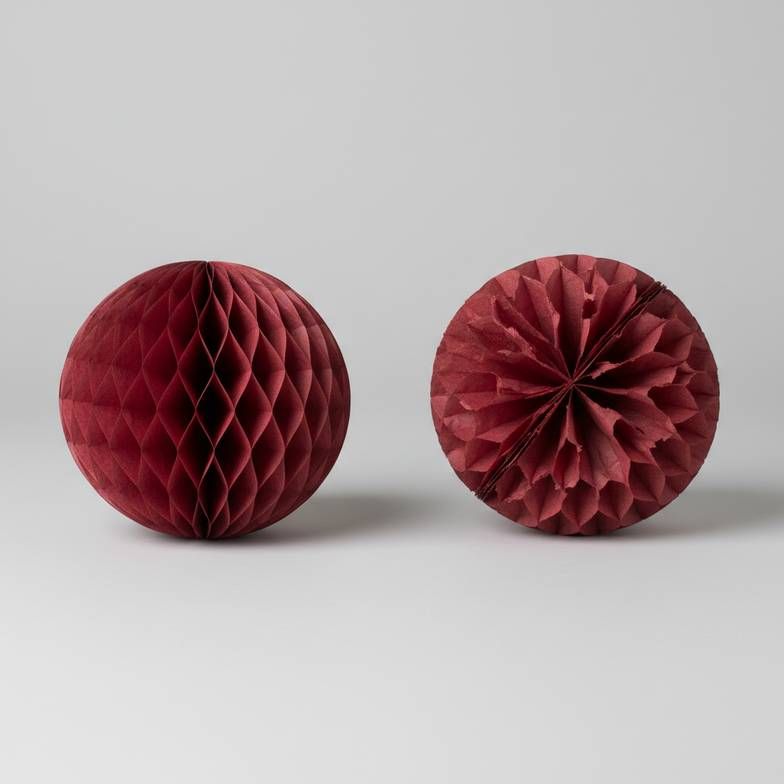
From my side of the desk at Mypaperbloom, I see buyers make the same mistake: they treat honeycomb decorations like a simple commodity. They're not. They are engineered structures. A low price often means shortcuts were taken in that engineering.
The Hidden Cost of Inferior Paper
Many buyers focus on paper GSM (grams per square meter). They'll ask for 100 GSM paper, assuming it’s a mark of quality. But here’s the inside scoop: the quality of the paper pulp and the length of the fibers matter far more for durability than just the weight. A supplier can use a heavy, low-quality paper made from cheap, short fibers. It might feel thick, but it will have poor "memory"—meaning it won't open into a perfect shape or will sag over time.
I remember a potential client who went with a cheaper supplier for a big order destined for a coastal city. The decorations looked fine in the pre-shipment photos. But after a week in the humid retail environment, they started to droop and lose their shape. The "savings" they made on the unit price were completely wiped out by the cost of having to replace the faulty displays mid-season. The real cost is the cost of failure.
Closure Methods and Their Impact on Usability
How a honeycomb decoration is held open is a critical detail that is often missing from a basic quote. If a supplier doesn't ask you about this, it's a warning sign they are not thinking about your end use.
| Closure Method | Best For | Pros | Cons |
|---|---|---|---|
| Magnets | Reusable displays, retail | Clean look, durable, easy to open/close | Highest cost |
| Adhesive Strip | One-time events, giveaways | Low cost, permanent bond | Can't be collapsed and reused, can fail in heat/humidity |
| Paper Clips | Budget-conscious projects | Very low cost, reusable | Looks less professional, can tear paper |
A quote that doesn't specify the closure method is incomplete. When we prepare a quote for a retail brand, we almost always default to recommending magnets, because we know their displays need to be stored and potentially reused. A low-ball quote is likely based on the cheapest option: a single adhesive strip that might not even last the duration of your event.
The Unseen Production Shortcuts
Where else can costs be cut? In the places you can't see on a spec sheet.
- Inconsistent Gluing: Automated machines apply glue lines to create the honeycomb cells. If the machine is poorly calibrated or the glue is low-quality, some cells won't open properly, creating a lopsided or incomplete shape.
- Cutting Die Sharpness: The outer shape is cut with a die. A dull die creates fuzzy, torn edges instead of a crisp, clean line. This is a tell-tale sign of a factory cutting corners on maintenance.
- Labor-Intensive QC: A good factory has people checking the decorations at multiple stages. A cheap factory skips these checks, hoping you won't notice the 5-10% of duds in your shipment until it's too late.
How can I truly compare quotes from different honeycomb paper decoration suppliers?
You've tried to standardize your request by asking all suppliers for the same specs, but the quotes you get back still feel like you're comparing apples and oranges. You have the specs, but you're not sure if the suppliers actually understand your vision or the challenges of your project.
The secret is to shift your mindset from comparing static specs to comparing how each supplier addresses your specific use case. A great quote from a partner-level honeycomb paper decoration supplier is a direct response to your needs, not just a fill-in-the-blanks price list.

Dive Deeper: From Specs to Scenarios
Let's get practical. The quality of the quote you receive is directly related to the quality of the information you provide.
Frame Your Request Around Scenarios, Not Just Specs
Stop sending requests like this: > "Please quote 5,000 units, 30cm honeycomb ball, red, 100 GSM paper."
A supplier receiving this can only compete on one thing: price. They will assume you want the absolute cheapest version of this item.
Instead, try framing your request as a scenario. This gives the supplier context and allows them to offer real solutions. > "We are planning a holiday window display for our 200 retail stores across North America. We need a quote for 5,000 units of a 30cm red honeycomb ball. The displays will be up for 8 weeks, from November 1st to January 1st. They need to look premium, be easy for store staff to assemble, and ideally be reusable for next year's campaign. Please provide options and recommendations."
Evaluating the Supplier's Response
Now, you're not just looking at the price. You're evaluating the quality of their thinking.
- A "Commodity" Supplier's Quote: Will send back a single price, likely for the cheapest option (adhesive closure, standard paper) to win the business. They've ignored all the rich context you provided.
- A "Partner" Supplier's Quote: Will come back with questions or options. This is what you want to see. They might say, "For reusability, we strongly recommend magnet closures. It adds $0.15 per unit, but ensures they can be stored flat without damage. For an 8-week display, have you considered a UV-resistant paper to prevent fading in sunny windows? Here is the cost difference."
When a buyer sends me a detailed scenario, it's a great sign. It allows me to move from being just a price provider to a problem solver. I can suggest a slightly different size that nests better for shipping to save them money on logistics, or recommend a paper finish that will interact with their store lighting beautifully. This collaborative approach is what separates good honeycomb paper decoration suppliers from the rest.
What should a quote for custom decorations include?
You've got a fantastic, unique idea for a custom shape or a private label collection. This is where the risks get even higher. How can you be sure that the beautiful design in your head doesn't turn into a production nightmare? The quote is your first and best tool for managing that risk.
A reliable quote for customization from a honeycomb paper decoration supplier must detail the entire process, not just the final price. This includes clear steps and costs for sampling, color matching, and pre-production proofing to ensure there are no surprises.
Dive Deeper: The Anatomy of a Trustworthy Customization Quote
When we work on a custom project, the quote is a roadmap. It breaks down the journey from your idea to the finished product. If a supplier's quote doesn't include these milestones, you should be very cautious.
The Critical Path of Customization
Your quote should clearly outline this process, ideally with associated costs and timelines for each stage:
- Technical Design & Structure: Before any paper is cut, the structure needs to be designed. For a new shape, this involves creating a digital file that maps out the glue lines. A good quote will mention this "digital sampling" or "structural design" phase. It ensures your idea is physically possible before you commit to expensive tooling.
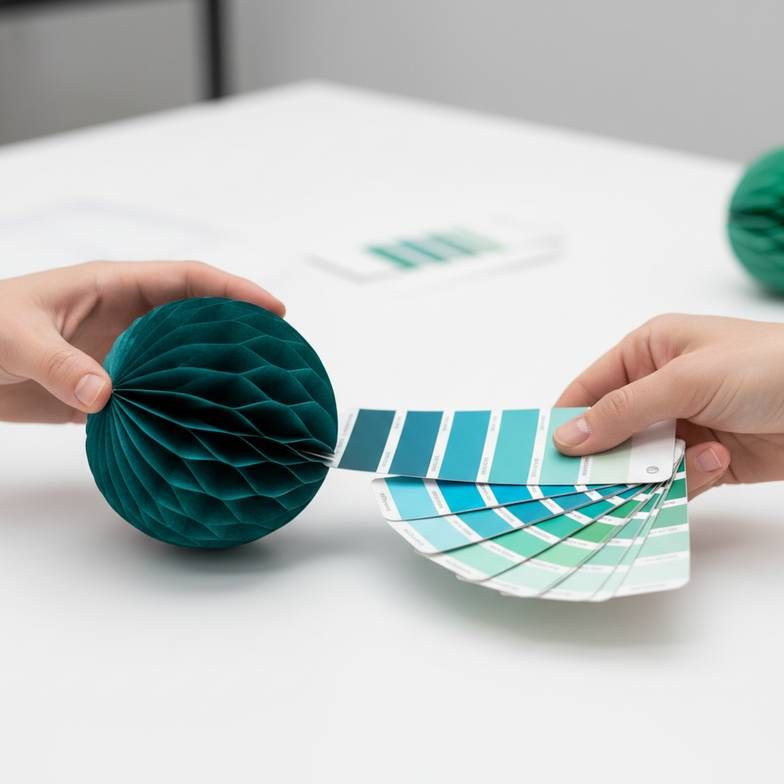
- Material & Color Matching: "Red" is not a specification. A professional quote will ask for a Pantone (PMS) code. It should also explain their process for matching it. At Mypaperbloom, we use controlled lighting booths to compare dyed paper stock against the client's Pantone chip. The quote should state that color will be approved via a physical paper swatch, as screen colors are never accurate.
- Pre-Production Sample (PPS): This is the most important step. The PPS is a final, finished sample made using the actual bulk materials and production methods. This is your golden sample. The quote must specify the cost for this (it's often a few hundred dollars, as it requires manual setup) and the timeline. Skipping a PPS to save money is one of the biggest gambles in sourcing. I've seen it lead to thousands of dollars in unsellable inventory.
- Packaging Design & Approval: How will your unique item be packed? A custom-printed retail box? A simple polybag with an instruction card? This all needs to be defined and approved, and the costs should be itemized in the quote.
A cheap customization quote that just gives a unit price without mentioning sampling, color matching, or a PPS isn't a bargain. It's a sign the supplier has a "you get what you get" attitude.
Frequently Asked Questions
What is paper GSM, and how important is it?
GSM stands for Grams per Square Meter. It's a measure of paper density or weight. While it's a useful spec, it's not the whole story. The quality of the wood pulp, the length of the paper fibers, and the honeycomb structure's engineering are more important for durability and appearance than weight alone.
Should I always ask for a pre-production sample (PPS)?
Yes, absolutely. For any custom order, a new supplier, or a large-volume project, the PPS is your insurance policy. It's the only way to be 100% sure that what you approved is what will be manufactured. The small cost and extra time are well worth it to avoid a bulk order disaster.
What's the difference between magnet and adhesive closures?
Magnets are the premium option, allowing the decoration to be opened and collapsed hundreds of times, making them perfect for retail displays that get stored and reused. Adhesive strips are a lower-cost, single-use solution suitable for one-time events where the decorations will be discarded afterward.
How much should I expect to pay for shipping?
This is impossible to answer without details, as costs vary dramatically based on volume, weight, and destination. Your supplier should provide detailed master carton specs in the quote: dimensions (L x W x H) and gross weight. With this information, you or your freight forwarder can get an accurate shipping quote.
Conclusion
Ultimately, when you compare quotes from honeycomb paper decoration suppliers, you're not just buying a product; you're choosing a partner. The cheapest price on paper rarely translates to the best value in reality. A truly competitive quote is one that demonstrates a supplier’s understanding of your project, outlines a clear path to success, and actively works to manage your risk. By shifting your focus from the unit price to the total picture—materials, construction, process, and logistics—you can choose a partner who is invested in your success. Selecting the right honeycomb paper decoration supplier is the first and most critical step to ensuring your seasonal program or event is a visual triumph.
If you're planning a project and want a quote that provides clarity instead of confusion, get in touch with us at Mypaperbloom. We're here to help you build a plan that works, from initial concept to final delivery.