Honeycomb Paper Decorations for Visual Merchandising: Choosing Formats by Store Zone
Struggling to select the right honeycomb paper decorations for visual merchandising? It’s a common problem. You want to create a stunning, immersive experience, but the sheer numbe
Struggling to select the right honeycomb paper decorations for visual merchandising? It’s a common problem. You want to create a stunning, immersive experience, but the sheer number of options is overwhelming. Picking the wrong format can lead to a flat, uninspired window display, a cluttered and unsafe aisle, or a logistical nightmare for your store teams during rollout. The good news is there’s a better way to think about it.
The best way to choose honeycomb paper decorations is not by finding a fixed product for each store zone, but by analyzing the unique goals and constraints of that space. For a window, prioritize visual impact. For an entrance, prioritize safety and traffic flow. For in-aisle displays, prioritize budget, consistency, and ease of deployment for store staff.
Now that you have the basic framework, let's dive into the specifics. This isn't about rigid rules, but about learning to ask the right questions. We'll explore how to reframe your thinking for each part of the store so you can select decorations that truly work.
How Do You Maximize Impact in a Store Window?
Is your window display failing to stop pedestrians in their tracks? It’s frustrating when you invest time and money into a concept that just doesn't have the "wow" factor, especially when competitors' windows are drawing crowds. The solution is to think like a stage designer, focusing on scale, depth, and drama.
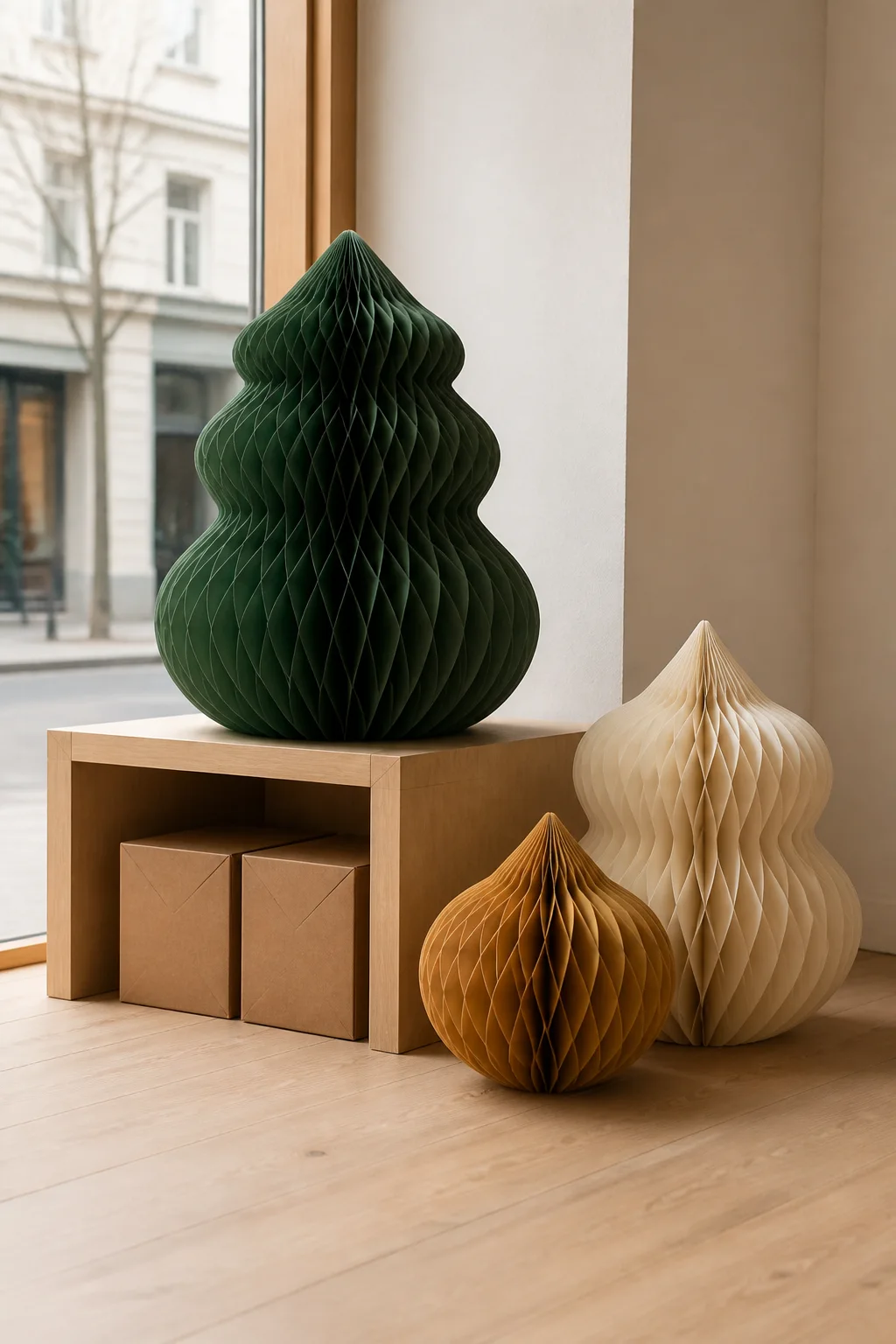
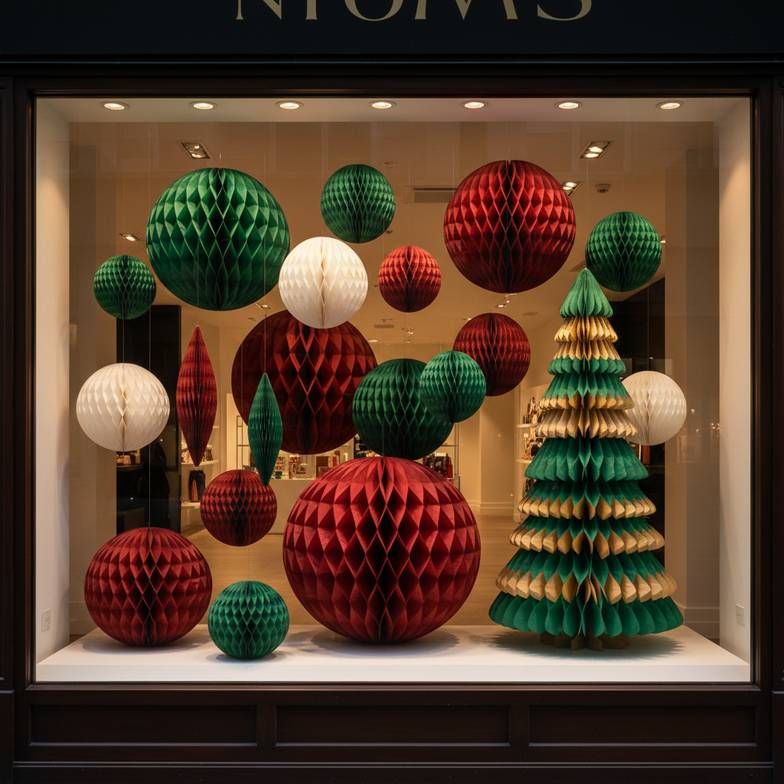
To maximize impact in a store window, you should prioritize large-format, three-dimensional honeycomb paper decorations. Select bold, oversized pieces that create visual depth and a clear focal point when viewed from a distance, such as giant hanging spheres, tall freestanding paper trees, or layered honeycomb fans.

Dive Deeper
A common question we get from visual merchandising teams is, "What's the best product for a window?" But the better question is, "What are the constraints and goals of my window?" Window displays are your brand's billboard. Their primary job is to interrupt the passerby's journey and create enough curiosity to pull them inside. This is where you go for drama, not subtlety.
Think in Layers and Scale
Your window is a stage, and the decorations are your actors. The audience is on the sidewalk, often viewing it from 5 to 20 feet away. Small, delicate items will get lost. You need scale.
- Create a Focal Point: Use one or two massive pieces to anchor the display. Think of a 5-foot-wide honeycomb snowflake for a winter theme or a cluster of giant, colorful paper baubles.
- Build Depth: Don't just line things up against the glass. Layering is key. Hang decorations at different depths—close to the glass, in the mid-ground with your products, and at the very back. This creates a rich, immersive scene that draws the eye inward. For example, you could hang smaller honeycomb balls in the foreground and progressively larger ones toward the back to create forced perspective.
- Consider the "Negative Space": Sometimes, the empty space is just as important as the decorated space. A few well-placed, large-scale items often have more impact than a window cluttered with dozens of small ones.
Material Specs vs. Real-World Performance
Many spec sheets focus on paper weight, measured in GSM (grams per square meter). While a higher GSM might suggest a more premium feel, it's not the only factor for a window display. From a manufacturing standpoint, the structural design is far more critical for large-format pieces.
What you should really be asking a supplier is:
- How are the glue lines applied? Consistent, strong glue lines are what prevent a large honeycomb structure from sagging or warping over a multi-week holiday campaign, especially under warm display lights.
- What is the cell size of the honeycomb? A smaller cell size creates a denser, more opaque look with richer color, while a larger cell size can be more translucent and playful with light.
- How does it interact with light? Ask if the paper has a matte or slight sheen. A matte finish diffuses light softly, preventing glare, which is often ideal for brightly lit window displays.
I remember a client who was fixated on using the heaviest paper possible for their large window ornaments. We ended up producing a sample with a slightly lighter paper but a denser honeycomb cell structure. It not only held its perfect spherical shape better over time but also captured the store's spotlights more beautifully. The final display was a huge success, proving that functional design trumps a single raw material spec.
What's the Priority for Entrances and Main Aisles?
You want to create a grand, welcoming entrance, but you're rightfully concerned about obstructing customer flow or creating a safety hazard. An improperly secured decoration can quickly become a liability or get damaged by shopping carts and high traffic, ruining the entire look. The key here is to balance visual appeal with durability and secure installation.
For high-traffic entrances and aisles, your top priorities are safety and durability. Choose honeycomb paper decorations for visual merchandising that can be hung securely from the ceiling, high above foot traffic. If using floor pieces, ensure they are exceptionally stable or have a slim profile that won't impede movement.

Dive Deeper
The transition from the street to the store interior is a critical moment in the customer journey. You want to continue the visual story from the window, but the functional requirements of this zone are completely different. Here, decorations must coexist with people, shopping carts, and strollers.
Safety and Installation Are Non-Negotiable
This is the number one concern for main aisles. A falling decoration isn't just an aesthetic problem; it's a safety risk.
- Go Vertical: Hanging decorations from the ceiling is almost always the best solution. It adds visual interest at a different eye level without creating a physical obstacle. Ensure you use appropriate ceiling hardware rated for the weight of the decorations.
- Verify Compliance: A common question we get is about flame retardancy. If your local regulations require it, don't just accept a "yes" from a supplier. Ask for the specific test report or certification document and verify that it applies to your region and the specific paper being used. This is a critical step in your due diligence.
- Mind the Flow: If you must use floor-standing decorations, like our foldable paper stools or display plinths, place them out of the direct line of traffic. Use them to create "islands" for featured products rather than barriers. Always check their stability.
Durability Is More Than Paper Thickness
In a high-traffic zone, decorations will inevitably be touched, bumped, or brushed against. What makes a honeycomb decoration durable in this context?
It's less about the paper's thickness and more about its construction.
| Feature | Why It Matters for Durability |
|---|---|
| Closure Method | Magnetic closures are far superior to adhesive strips or paper clips for these zones. They provide a secure, seamless close that is less likely to pop open when bumped. They also allow for repeated use. |
| Cover Material | The top and bottom "covers" of the honeycomb structure should be made of a stiff, heavy cardstock. This reinforces the shape and protects the more delicate honeycomb edges from getting crushed. |
| Glue Application | Just like with window displays, consistent glue lines are vital. Poor gluing can cause layers to separate if the decoration is jostled, leading to a collapsed or misshapen look. |
Buyers often focus on GSM, but a decoration with a robust magnetic closure and reinforced covers will outperform a heavier-paper product with flimsy paper clips every time in a busy aisle.
How Can You Effectively Use Decorations on Shelves and In-Aisles?
You want to carry your design theme throughout the entire store, but your budget is tight and you need something your store teams can deploy quickly and consistently across dozens or hundreds of locations. The biggest risk here isn't a lack of impact, but inconsistent execution and budget overruns from decorations that are too complex or time-consuming to assemble.
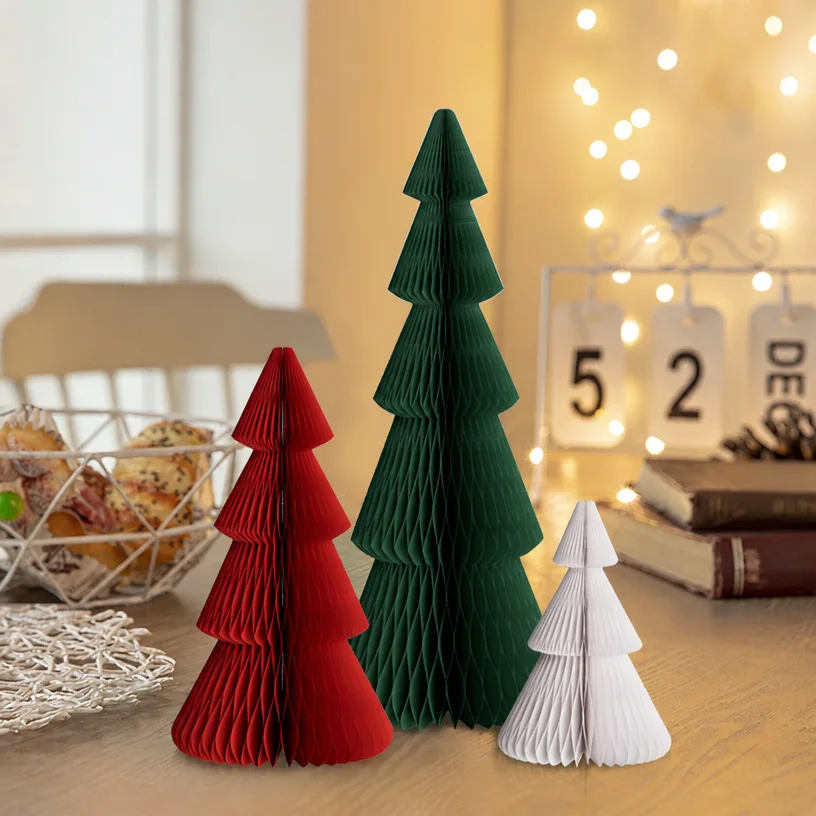
The most effective way to use decorations on shelves and in-aisle is to choose smaller, cost-effective, and easy-to-assemble honeycomb paper decorations for visual merchandising. Focus on formats like tabletop trees, mini-ornaments, or small honeycomb balls that require zero tools and can be opened and placed in seconds.

Dive Deeper
This is where the campaign truly lives or dies. Your window and entrance set the stage, but the on-shelf and point-of-sale displays are where the customer makes a purchase decision. The goal is to add accents of color and texture that reinforce the theme without overwhelming the product.
Design for Effortless Deployment
Your store associates are busy. If a decoration takes more than 30 seconds to figure out, it's likely to be assembled incorrectly or, worse, left in the stockroom.
- Simplicity is King: The best decorations for this zone are often self-contained. A honeycomb ball or tree with embedded magnets that snap open is perfect. There are no extra parts to lose and no instructions needed.
- Packaging for Rollout: When we work with large retail brands on multi-store rollouts, we spend a lot of time planning the packaging. We pack decorations flat to minimize shipping volume, and often pre-assort kits for each store. This saves countless hours of work on the receiving end. Ask your supplier how their packaging strategy can support your deployment process.
- Consistency is Key: For a brand to look professional, the displays need to be consistent from store to store. This means the decorations must be uniform. This is a manufacturing challenge related to quality control. A reliable supplier should be able to guarantee that the color, shape, and opening mechanism are identical across a run of tens of thousands of units. Always approve a pre-production sample before a mass order.
Achieving a Premium Look on a Budget
"Cost-effective" doesn't have to mean "cheap-looking." Honeycomb paper decorations are brilliant for this because they offer a high perceived value for a relatively low unit cost. The texture, color, and three-dimensional shape feel more special and artisanal than flat printed cardboard or molded plastic.
To maximize your budget:
- Focus on Color and Texture: A simple shape in a beautiful, on-trend color palette looks far more sophisticated than a complex shape in a garish color. Work with your supplier on custom colors that match your brand's seasonal story.
- Use in Clusters: A single small honeycomb ball might look lonely, but a cluster of three in varying sizes and complementary colors creates a dynamic, high-impact accent next to a product.
- Mix and Match: Use a few "hero" formats—like a small tabletop tree—and supplement with very simple, low-cost honeycomb balls to fill out the display.
The secret to in-store decoration isn't spending more money; it's about making smart, strategic choices that empower your teams and create a consistent brand story, one shelf at a time.
Frequently Asked Questions
What paper weight (GSM) is best for honeycomb decorations?
There's no single "best" GSM. A heavier paper feels more premium but can make large structures sag if not engineered correctly. Focus on the end-use. For large hanging items, structural integrity and glue strength are more important than paper weight. For small tabletop items, a moderate GSM is perfectly fine.
Are magnetic closures better than clips or adhesive?
For most retail applications, yes. Magnetic closures provide a clean, seamless look, are incredibly fast for store staff to open, and allow the decorations to be folded down and reused for future campaigns. Adhesive is single-use, and clips can look less professional and are easy to lose.
How do I ensure color consistency across a large order for multiple stores?
This is a critical conversation to have with your manufacturer. You should always approve a physical pre-production sample. Then, ask your supplier about their process for managing color, such as using color spectrophotometers and retaining approved samples to compare against the bulk production run.
What should I ask a supplier about flame retardancy?
Don't just ask, "Is it flame-retardant?" Instead, ask, "Can you provide a test report for flame retardancy that is valid in my specific market (e.g., USA, EU)?" A professional supplier should be able to provide documentation for you to verify, but be aware this may apply to specific paper stocks and could impact costs and lead times.
Conclusion
Ultimately, choosing the right honeycomb paper decorations for visual merchandising isn't about following a rigid catalog. It's about adopting a strategic framework. By analyzing each store zone's unique trade-offs—balancing visual impact in the window, safety in the aisles, and deployment efficiency on the shelf—you can build a more effective, cohesive, and successful retail experience. This thoughtful approach transforms your displays from simple decoration into a powerful tool that guides the customer journey and strengthens your brand.
Ready to plan a seasonal display that's both beautiful and practical? Contact us at Mypaperbloom. We can help you develop a custom collection of foldable honeycomb paper decorations tailored to the specific needs of your store zones and brand identity.