Honeycomb Paper Decoration Samples: What to Check Before Bulk Production
Receiving your honeycomb paper decoration samples can feel like the final step before a big win, but a quick visual check can lead to disastrous bulk orders. You’re worried that th
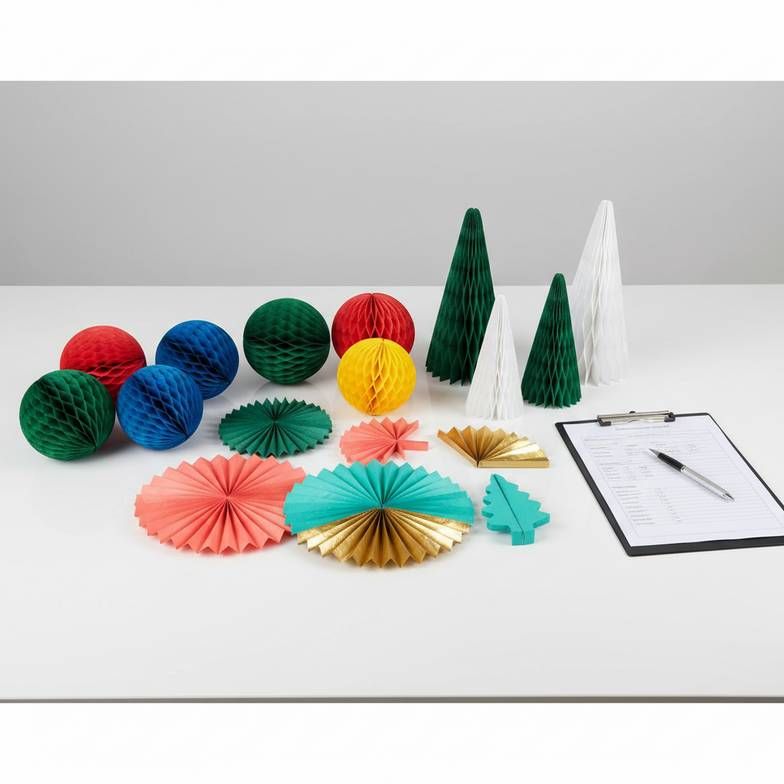
Receiving your honeycomb paper decoration samples can feel like the final step before a big win, but a quick visual check can lead to disastrous bulk orders. You’re worried that the final shipment won't match the one perfect piece in your hands, costing you time, money, and market opportunities. The solution isn't just to look at the sample, but to test it with your final production risks in mind.
When you receive honeycomb paper decoration samples, you must check more than just color and size. The most critical evaluation involves testing structural integrity (how it opens, closes, and holds its shape), functional durability (especially the closure mechanism like magnets or adhesive), and confirming manufacturing tolerances with your supplier for acceptable variations in the final batch. You should also inspect the packaging to ensure it protects the product and is optimized for shipping.
Approving that sample is a huge milestone. But it's not a finish line; it's a critical checkpoint. I've seen countless buyers breathe a sigh of relief when a beautiful sample arrives, only to face issues later. Let's break down how to turn that sample inspection from a simple "looks good" into a robust risk assessment for your entire project.
What Structural and Functional Tests Should I Perform on Samples?
You’ve unboxed a sample that looks exactly like the product photos. The color is spot-on. But will it function correctly when your end customer opens it? A decoration that tears, won't open fully, or sags after an hour on display can ruin a retail program or event.
The most critical tests go beyond what you can see. You need to simulate the product's entire lifecycle, from unboxing to display and potential reuse. This means physically handling and manipulating the sample to find its potential weak points before they become a bulk production nightmare.
Dive Deeper: From Visuals to Verifiable Function
From my experience, the biggest sample-related problems don't come from color; they come from function. A sample is your one chance to physically vet the engineering of the product. When I guide clients through a sample review, I tell them to put it through its paces. Here’s what you should be testing:
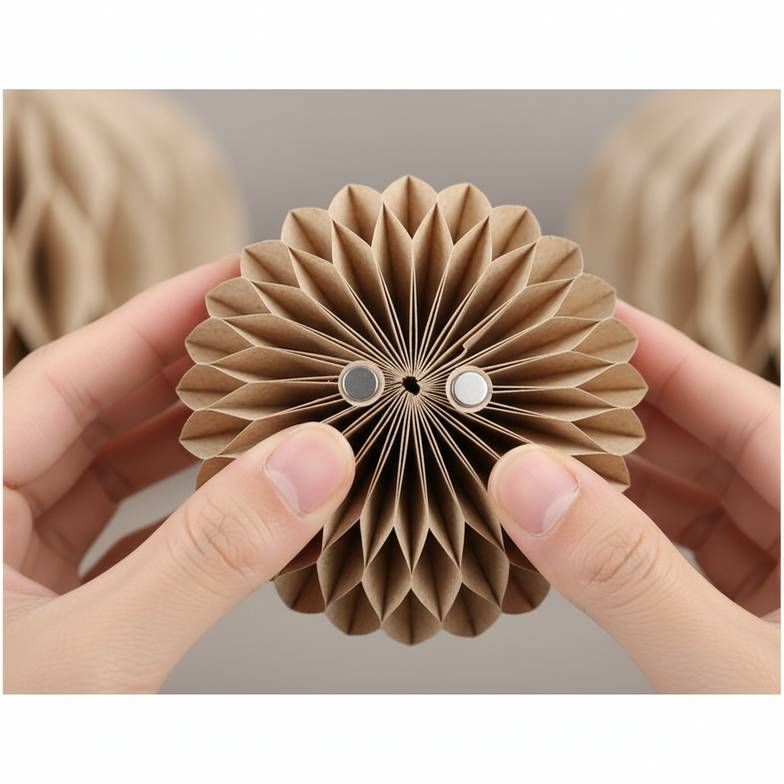
- The Unfolding & Folding Mechanism: This is priority number one. Unfold the decoration fully. Does it open into a complete, uniform shape without excessive force? Or do some cells stick together, creating a lumpy or incomplete look? Pay close attention to the spine where the paper is glued. It should be strong but flexible. Now, try to fold it back up. A product designed for reuse should collapse easily without creasing or damaging the paper. If it’s hard to fold, customers will likely damage it, leading to returns and negative reviews.
- Closure Strength & Type: How does the decoration stay open?
- Magnets: Are they strong enough to hold the shape securely? If you gently shake the ornament, do the magnets separate? Weak magnets are a common cost-cutting measure that leads to sagging, partially closed decorations on the shelf.
- Adhesive Strips: If it uses a peel-and-stick adhesive for a one-time setup, is the adhesive strong? Does the paper backing peel away cleanly without tearing the product itself?
- Paper "Memory" and Cell Uniformity: Once opened, let it sit for a while. Then fold it back up and store it for an hour before opening it again. Does it spring back to its full shape, or does it "remember" being compressed and look slightly deflated? This tests the quality and resilience of the paper. Also, look at the honeycomb cells themselves. They should be relatively uniform in size and shape. Irregular cells often indicate inconsistent gluing or tension during manufacturing, which can lead to a distorted final appearance.
- Hanging and Mounting Points: If it’s a hanging decoration, inspect the string or loop. Give it a gentle but firm tug. Does it feel secure? Is the hole it's threaded through reinforced, or is it just a simple punch-hole that could easily tear? For tabletop pieces, check the base. Is it flat and stable, or does the decoration wobble?
Treating your sample like a real-world product is the only way to catch these functional flaws. A sample that looks great but fails these simple physical tests is a major red flag for bulk production.
How Do Honeycomb Paper Decoration Samples Relate to Batch Tolerances?
You’ve approved a flawless pre-production sample. So you expect every single one of the 10,000 units in your bulk order to be an exact carbon copy, right? This expectation can cause serious friction with your supplier. The reality is that manufacturing, especially with natural materials like paper, involves slight variations.
A perfect sample doesn't guarantee a perfect batch. Instead, the sample should be used as a benchmark to agree upon acceptable manufacturing tolerances. This is the small, defined range of variation in color, size, or finish that you and your supplier agree is acceptable in the final mass production.

Dive Deeper: Shifting from Perfection to Predictable Quality
The goal of evaluating honeycomb paper decoration samples isn't to get one perfect unit; it's to establish a clear, documented standard for what constitutes an acceptable unit in your bulk order. This is a conversation, not a command. Here’s how to manage it.
Understanding Inherent Variations
First, you need to know where variations are most likely to occur:
- Color: Paper is dyed in large batches or lots. While we strive for consistency, there can be minute shifts in hue from one dye lot to another. A color that's a 99% match to a Pantone code is a manufacturing success. Chasing a 100.00% match on every piece is unrealistic and will only lead to delays and higher costs.
- Size: Honeycomb structures are assembled and cut. A tolerance of +/- 1-3% in dimension (e.g., a few millimeters on a 30cm ball) is standard in the industry. This is typically imperceptible to the end user but is a reality of the production process.
- Material Finish: The texture or sheen of paper can have minor variations. This is rarely an issue but is worth noting if you have a very specific finish requirement.
Establishing Clear Tolerances
Instead of just saying "this sample is approved," you need to provide more specific feedback. This turns a subjective review into an objective standard.
- Reference Pantone Codes: Don't just approve a color visually. Document it with a Pantone (PMS) code. Your feedback should be: "Color approved. We confirm that production should match Pantone 185 C, with the approved sample as the primary visual reference." This gives the factory a universal standard to aim for.
- Define a "Range Board": For critical projects, you can ask your supplier for a "range board" or a small set of samples that show the acceptable extremes of variation. For example, you might receive three samples: the "perfect" target color, one that is slightly lighter, and one that is slightly darker. You can then sign off on this entire range, confirming that any unit falling within it is acceptable. This is an incredibly powerful tool for preventing disputes later.
- Confirm Dimensions with Tolerances: Your approval should state: "Dimensions of 30cm diameter approved, with an acceptable tolerance of +/- 3mm." This shows you understand the manufacturing process and sets a clear, measurable QC metric for the final inspection.
By discussing and documenting tolerances when you approve your honeycomb paper decoration samples, you are replacing ambiguity with agreement. You’re telling your supplier exactly what your quality control team will be looking for, making the final inspection process smoother and less contentious for everyone involved.
How Should I Tailor My Sample Checklist for My Specific Use Case?
A buyer sourcing decorations for a high-end retail brand has vastly different priorities than someone organizing a one-time corporate event. Using a generic, one-size-fits-all checklist is a dangerous shortcut. You risk over-engineering for a disposable item or, worse, under-evaluating a product that needs to look perfect after being handled by dozens of customers.
The most effective sample evaluation is one that is built around your specific commercial risks and end-use case. You need to ask: What does this product need to do? The answer will tell you exactly what to prioritize in your sample check.

Dive Deeper: Context-Driven Quality Checks
Your checklist must be a direct reflection of your business goals. For example, I recently worked with two different clients. One was developing a line of Christmas decorations to be sold in gift shops. The other was creating a large-scale installation for a three-day trade show. Their sample checklists were completely different.
Let's break down how to think about this using those two common scenarios:
| Feature to Check | High-End Retail Product | One-Time Event Display |
|---|---|---|
| Primary Goal | Customer satisfaction, brand reputation, reusability. | Maximum visual impact, ease of setup, budget adherence. |
| Closure Mechanism | Critical. Must be durable for repeated use. Magnets are preferred. Check strength and alignment rigorously. | Less critical. Strong adhesive is fine. Needs to hold for the event's duration, but reusability is not a concern. |
| Paper Durability | High priority. Test resistance to tearing and creasing during repeated folding/unfolding. Check paper memory. | Lower priority. Must survive shipping and one-time setup. Minor fragility is acceptable if the visual is strong. |
| Individual Packaging | Critical. Must protect the product, look good on a shelf, and include clear instructions. Check box thickness and design. | Not a primary concern. Simple polybag protection is often sufficient. The focus is on the master carton for shipping. |
| Color Consistency | High priority. Customers buying multiple items from a collection expect a perfect match. Tighter tolerances are required. | Moderate priority. Overall color theme is important, but slight variations between individual pieces are less noticeable. |
| Hanging/Mounting | Critical. Must be robust and user-friendly. A weak string can lead to returns and bad reviews. | Critical. Must be secure enough to last the event's duration without falling. Check for easy installation points. |
As you can see, the "right" things to check are entirely dependent on context.
Building Your Custom Checklist
Before your honeycomb paper decoration samples even ship, draft a checklist based on these questions:
- Who is the end user? A retail customer, a visual merchandiser, an event planner?
- How many times will this product be used? Once, or multiple times across a season?
- What is the single biggest risk of failure? A product that looks cheap? A product that breaks during setup? A product that doesn't survive shipping?
- How will it be packaged and sold? Individually in a retail box, or in bulk for a project team?
Answering these questions will help you move beyond a generic "quality check" and into a strategic risk assessment tailored to your specific project.
Why Is Checking Packaging So Critical with My Honeycomb Paper Decoration Samples?
It's easy to get so focused on the decoration itself that you completely forget about what it comes in. This is a mistake I see buyers make all the time. They approve a beautiful product sample, only to receive a bulk shipment where 15% of the items are crushed, or they get a surprise bill for volumetric shipping weight because the cartons are inefficiently packed.
Checking the packaging with your honeycomb paper decoration samples is not an optional extra; it's a critical part of de-risking your supply chain. The packaging determines if your product arrives safely, if it’s presentable to the end user, and if your shipping costs are optimized.

Dive Deeper: The Hidden Costs of Poor Packaging
When you request samples, you should always ask for them to be sent with the proposed retail and master carton packaging. Here’s what you’re looking for and why it’s so important.
For the Individual (Retail) Packaging:
- Protection: Does the box or bag adequately protect the delicate paper structure? Honeycomb decorations are light, but they are vulnerable to being crushed. The packaging should be rigid enough to withstand bumps and drops. I recommend performing a simple "drop test" from waist height to see how it holds up.
- Presentation: If it's a retail product, does the packaging reflect your brand quality? Is the printing clear? Does it open easily without damaging the product inside? The unboxing experience is part of the product.
- Instructions: For any item that requires assembly (even simple unfolding), are there clear, simple instructions printed on the packaging or included as an insert? Lack of instructions is a top reason for customer complaints and returns.
For the Master Carton (Shipping) Packaging:
- Freight Optimization: This is the big one that impacts your bottom line. Your supplier should be able to tell you the master carton dimensions, how many units fit inside, and the total weight. You or your freight forwarder can use this data to calculate your CBM (cubic meters) and estimate shipping costs. Inefficiently packed cartons with a lot of empty space will inflate your shipping bill, especially with ocean and air freight being so sensitive to volume.
- Durability and Labeling: Is the master carton made of sturdy, double-walled cardboard? Will it withstand the rigors of international shipping and warehouse handling? Check that the carton includes all necessary shipping marks: SKU, quantity, country of origin, carton number (e.g., "1 of 200"), and any required warning labels. Getting this right at the sample stage prevents major logistical headaches later.
By approving the packaging alongside the product, you are ensuring your investment arrives intact, is commercially ready, and doesn't come with a hidden surcharge in the form of preventable damage or excess freight costs. Don't let packaging be an afterthought.
Frequently Asked Questions
What is a reasonable tolerance for color variation in honeycomb paper?
A reasonable tolerance is a slight variation that is not immediately obvious to the naked eye. In manufacturing terms, this is often managed by referencing a Pantone (PMS) code. While a 100% exact match across thousands of units is impossible due to different paper and dye lots, the color should fall within an agreed-upon range of the specified Pantone color.
Should I have to pay for honeycomb paper decoration samples?
It depends. For standard, off-the-shelf items, many manufacturers may provide a few pieces for free if you cover the shipping cost. However, for custom-developed samples that require new tooling, custom colors, or specific printing, it is standard practice to pay a sample development fee. This fee often gets credited back to you if you place a bulk order.
What should I do if the sample isn't right?
Provide clear, specific, and documented feedback to your supplier immediately. Don't just say "the color is wrong." Say "The color is too dark. It needs to be closer to Pantone 185 C. Please see the attached photo for reference." Provide photos, videos, and written notes. A good supplier will use this feedback to produce a revised sample for your approval.
How many samples should I request?
For a standard review, 2-3 samples are usually sufficient. This allows you to keep one as a "control" sample, send one to a colleague for a second opinion, and use one for destructive testing (like testing tear strength or adhesive). If you're establishing a "range board" for color or finish, you may need more.
Conclusion
Ultimately, evaluating honeycomb paper decoration samples is about shifting your mindset from simply approving a product to actively managing risk. A thorough check is your best defense against production errors, shipping damage, and commercial failures. By testing for structural function, establishing clear manufacturing tolerances, tailoring your checklist to your specific end-use, and never overlooking the packaging, you transform the sample from a simple object into a powerful strategic tool. This proactive approach builds a stronger partnership with your supplier and ensures the bulk order that arrives is exactly what your business needs to succeed.
If you're ready to source honeycomb paper decorations with confidence, our team is here to help. We believe in a transparent sampling process that aligns our production with your goals. Contact us today to discuss your project and get your samples underway.