Honeycomb Paper Decoration Quality Checklist: Shape, Color, Opening and Closure
Sourcing honeycomb paper decorations feels like it should be straightforward, but the risk of getting it wrong is high. You’re worried that a large order might not live up to the p
Sourcing honeycomb paper decorations feels like it should be straightforward, but the risk of getting it wrong is high. You’re worried that a large order might not live up to the promise of that first perfect sample, leading to inconsistent retail displays and a blown budget. The solution isn't a better checklist, but a better way of thinking. The most effective honeycomb paper decoration quality checklist is actually a list of questions that helps you qualify your supplier’s process, not just their product.
A successful honeycomb paper decoration quality checklist focuses on evaluating a supplier's capability for consistency rather than just a single sample's features. It involves asking targeted questions about their processes for maintaining uniform shape integrity across a batch, their color management system for preventing shade variations, and their rationale for recommending a specific opening and closure mechanism (like magnets or adhesive) based on your specific end-use and budget.
So, we've established that a simple "good/bad" checklist won't cut it. Let's dive into the three critical areas—shape, color, and closure—and reframe them as a powerful set of questions you can use to de-risk your next sourcing project.
How Do You Truly Judge the Shape Quality in a Honeycomb Paper Decoration Quality Checklist?
You’ve just received a "golden sample" from a potential supplier, and it looks fantastic. But a common fear I hear from buyers is, "How do I know the 5,000th piece will look and perform this well?" This is a valid concern, especially for multi-store rollouts where consistency is everything. The key is to shift your focus from initial appearance to long-term structural integrity.
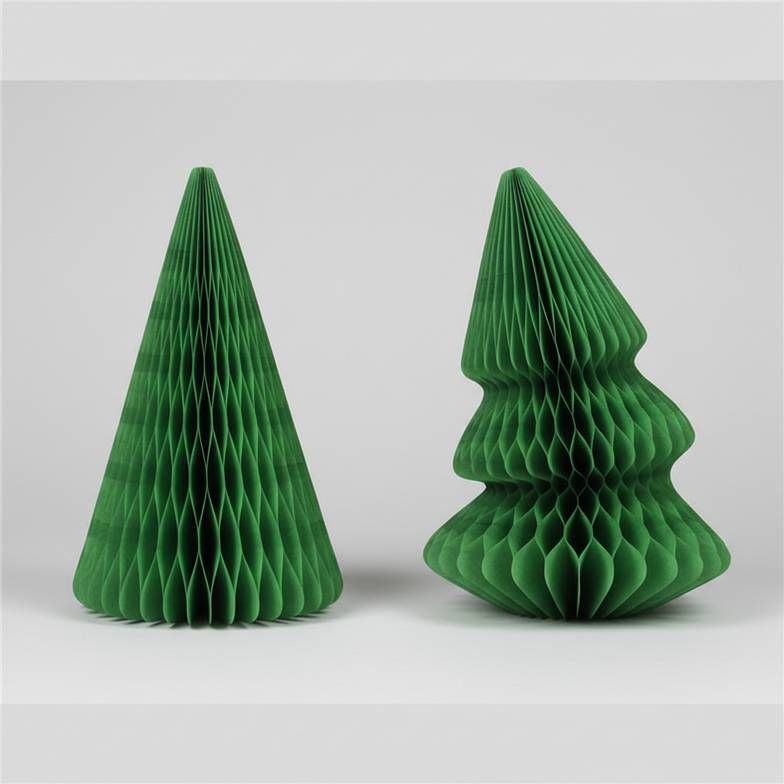
True shape quality isn't about a decoration looking perfect once. It's about its ability to hold that intended form across an entire production run and after being handled, opened, and closed multiple times by retail staff or customers.
Dive Deeper: From "Perfect Sample" to "Consistent Batch"
The biggest trap in sourcing is falling in love with a single perfect sample. A skilled technician can make one or two beautiful pieces by hand. Scaling that to thousands of units with consistent quality is an entirely different challenge. The real quality lies in the manufacturing process.
The "bones" of a honeycomb decoration are the paper and the glue. The shape's integrity depends entirely on the precision and consistency of the glue pattern.
- Uniform Glue Lines: Inconsistent glue application—too much, too little, or unevenly spaced—is the number one cause of misshapen or sagging decorations. When you open it, some cells might be stuck together while others are too loose.
- Cell Structure: The density of the honeycomb cells also plays a role. A denser structure (more cells per inch) often results in a more robust and stable shape, but it also uses more paper and can increase costs.
Instead of just approving the sample's shape, you should be qualifying the supplier’s ability to replicate it. We've seen cases where buyers approve a sample, only to receive a bulk order with a 10-15% rate of items that won't open properly or look distorted. This is a direct result of poor process control during mass production.
The Real-World Test: Durability and Repeated Use
Think about how your decoration will actually be used.
- Single-Use Display: If it's for a one-time event or a short-term promotional window, the main concern is that it opens correctly the first time.
- Reusable Retail Product: If you're selling it to a consumer or reusing it for multiple seasons, it needs to withstand being opened, displayed, folded back down, and stored.
I once worked with a visual merchandising team that planned to reuse a large set of honeycomb ornaments for their Christmas displays for three years. In the first year, they looked great. By year two, about a quarter of them started to sag or wouldn't open into a full sphere because the paper had softened and the structure had weakened from handling. Their initial honeycomb paper decoration quality checklist had focused on the initial look, not long-term durability.
Questions to Ask Your Supplier About Shape:
- What is your process for ensuring uniform glue application and cell structure across a large production run?
- How do you test for shape retention after the decoration has been opened and closed multiple times (e.g., 10 or 20 cycles)?
- Can you describe your Quality Control checkpoints for shape integrity during and after production?
- For my specific design, what is the paper weight (GSM) you recommend to ensure it holds its shape without sagging?
What's the Biggest Risk with Color in a Honeycomb Paper Decoration Quality Checklist?
You've spent weeks finalizing the perfect color palette for your seasonal collection, and you’ve approved the Pantone color match from your supplier. The problem is, color risk isn't about getting the wrong color. It's about getting multiple, slightly different versions of the right color in the same shipment.
The biggest risk with color is inconsistency across the production batch. This can undermine a coordinated retail display, making an entire collection look cheap and unprofessional, even if each individual piece is technically "correct."
Dive Deeper: Why a Color Swatch Isn't Enough
Approving a color based on a single paper swatch sent to your office is risky for two main reasons: paper dye lots and lighting.
- Paper Dye Lot Variation: Paper mills produce paper in massive batches called "lots." Even with modern technology, there can be slight variations in color from one lot to the next. If your supplier runs out of paper from one lot mid-production and switches to a new one, you could end up with two slightly different shades of "red" in the same order. A good supplier anticipates this and reserves enough paper from a single dye lot to complete your entire order.
- Metamerism (The Lighting Problem): This is a phenomenon where two colors appear to match under one light source (e.g., the fluorescent lights of a factory) but look different under another (e.g., the warm LED spotlights in your retail store). I've heard from many clients who were happy with production photos, only to be disappointed when they saw the products in their own environment.
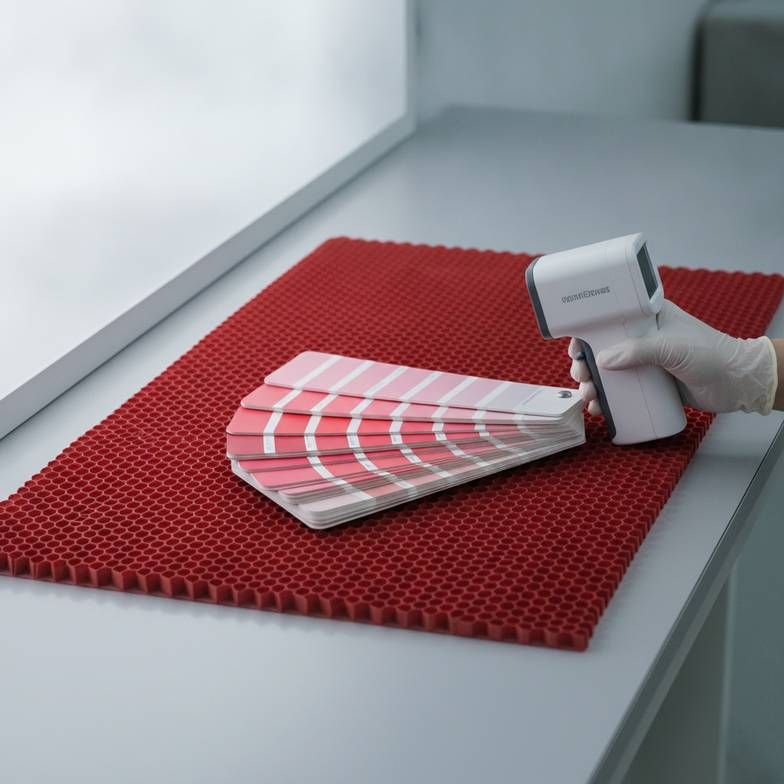
A professional supplier mitigates these risks using a controlled color management system. This isn't just about matching a Pantone chip; it's about ensuring that match is consistent from the first piece to the last.
The Hallmarks of a Good Color Management System
When you're evaluating a supplier, you want to hear that they have objective, process-driven controls for color.
- Controlled Light Box: They should be using a standardized light box with multiple settings (e.g., D65 for daylight, TL84 for store light) to check color samples against your standard. This ensures you're both looking at the color under the same conditions.
- Spectrophotometer: For very large or color-critical orders, some manufacturers use a spectrophotometer. This device measures color digitally, removing all human subjectivity. It provides a "Delta E" value, which is a numerical representation of the distance between two colors. You can agree on an acceptable Delta E tolerance with your supplier.
- Clear Standards: All color approvals should be documented with physical samples (a "master" sample) and clear Pantone (PMS) codes.
Questions to Ask Your Supplier About Color:
- What is your process for managing color consistency if you need to use different paper dye lots for my order?
- Do you use a light box to evaluate color? If so, can you confirm the match under D65 and a typical store light setting?
- How do you ensure the color of the final product matches the approved pre-production sample? What is your QC procedure?
- For color-critical projects, can you provide color measurement data (Delta E values)?
Are Magnets Always Better Than Adhesive for Honeycomb Decoration Closures?
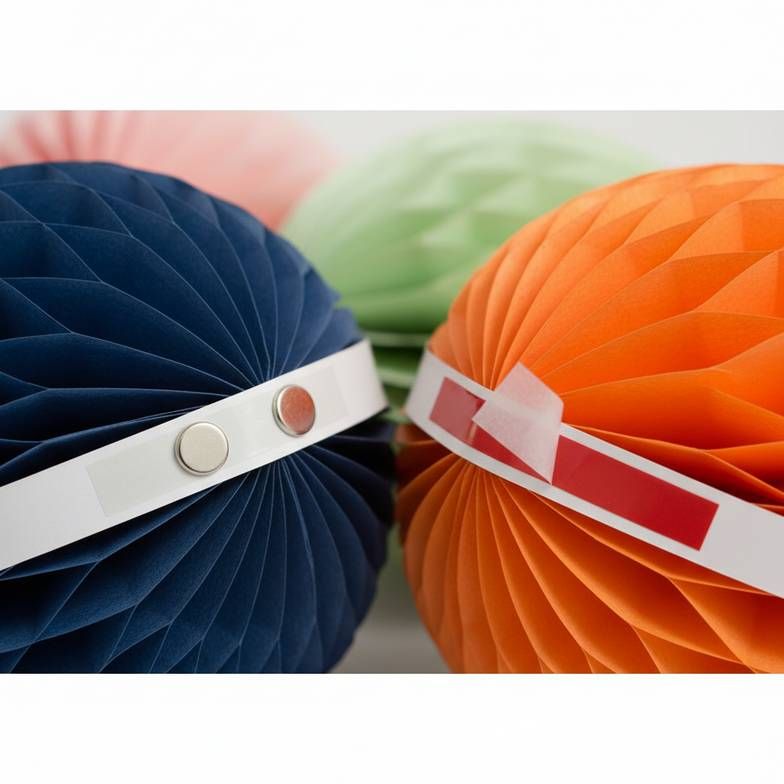
There's a common belief among buyers that magnetic closures are the "premium" or "high-quality" option, while adhesive tape is the "cheap" one. This leads many to insist on magnets without considering the context. But for a honeycomb paper decoration quality checklist, the closure isn't about "good vs. bad"—it's a strategic choice.
No, magnets are not always the better choice. Magnets are ideal for decorations intended for multiple uses, such as a retail product for consumers. However, double-sided adhesive is often a more practical and cost-effective solution for single-use commercial displays or large-scale promotional rollouts.
Dive Deeper: A Strategic Trade-Off
Choosing between magnets and adhesive is a balancing act between reusability, user experience, budget, and display purpose. Insisting on one over the other without analyzing your needs can lead to overspending or a poor user experience.
Here’s a simple breakdown of the trade-offs:
| Feature | Magnetic Closure | Adhesive (Double-Sided Tape) Closure |
|---|---|---|
| Reusability | Excellent. Can be opened and closed hundreds of times. | Limited. Typically for one-time or semi-permanent use. |
| User Experience | Effortless and clean. Snaps into place satisfyingly. | Simple, but can be tricky to align perfectly. |
| Unit Cost | Higher, due to material and assembly costs. | Lower, making it ideal for budget-conscious projects. |
| Display Permanence | Can be easily folded and stored away. | More permanent. Once stuck, it's not meant to be opened. |
| Ideal Application | Retail products for sale, reusable seasonal decor. | Single-use event decor, large-scale visual merchandising rollouts. |
When to Specify Magnets
Magnets are the right choice when the end-user is expected to open and close the decoration multiple times.
- Products for Retail Sale: If a customer is buying the decoration to use in their home year after year, the reusability and satisfying "snap" of magnets add significant perceived value.
- In-House VM Kits: If your visual merchandising team is reusing the same set of decorations for different stores or seasons, magnets make setup, teardown, and storage much more efficient.
When Adhesive Makes More Sense
Adhesive tape is a smart, economical choice when the decoration's life is temporary.
- Large-Scale Promotional Rollouts: If you're sending 500 honeycomb balls to 500 stores for a two-week promotion, the added cost of magnets is likely unnecessary. The staff will set it up once, and it will be discarded after the event.
- Budget-Driven Projects: When unit cost is the primary driver, a high-quality adhesive is a perfectly functional solution that gets the job done without breaking the bank.
The quality question here isn't "magnets or tape?" but "what kind of tape?" A good supplier will use a strong adhesive that bonds well to the paper and won't fail mid-display.
Questions to Ask Your Supplier About Closures:
- Based on my application (e.g., single-use display), which closure do you recommend and why?
- If we use magnets, what is their strength (e.g., N35)? How are they secured within the paper to prevent them from falling out?
- If we use adhesive, what type of tape do you use? Is it a strong, permanent bond or a repositionable one?
- Can you provide a cost comparison for both options based on my design and order volume?
Frequently Asked Questions
How do I check for material quality beyond color?
Focus on the paper's weight, specified in grams per square meter (GSM). A higher GSM generally means a more durable and rigid decoration, but it also increases cost and weight. Also, consider the paper's finish (e.g., matte, gloss) and ask your supplier about their paper sourcing to ensure consistency.
What is a reasonable defect rate for a bulk order of honeycomb decorations?
This should be clearly defined in your purchase agreement using an AQL (Acceptable Quality Limit) standard. For example, you might agree on AQL 2.5 for major defects (like not opening) and AQL 4.0 for minor defects (like a small smudge). A professional supplier should be familiar with AQL and able to commit to a specific standard.
Should I ask for certifications like FSC?
Yes, if sustainability is part of your brand's requirements, you should absolutely ask for certifications like FSC (Forest Stewardship Council). However, always treat it as a document to be verified. Ask for the supplier's certificate number and check its validity and scope on the official FSC database.
How does packaging affect the quality of honeycomb paper decorations?
Packaging is critical. Honeycomb decorations are shipped flat, but they can still be crushed or damaged if not packed correctly. Good packaging—like sturdy outer cartons and proper inner packing—ensures the product arrives in perfect condition, protecting the shape integrity and preventing creases or tears.
Conclusion
Ultimately, a truly effective honeycomb paper decoration quality checklist is less of a static document and more of a dynamic conversation with your supplier. It’s about moving beyond surface-level judgments and digging into the processes that ensure consistency and suitability for your specific needs. By focusing on shape integrity across a batch, a robust color management system, and the strategic choice of a closure mechanism, you transform your sourcing from a gamble into a calculated business decision. The best suppliers aren't just selling a product; they are providing a manufacturing solution.
If you are looking for a partner who understands the difference and can help guide you through these critical quality decisions, please reach out. We're here to help you build your next collection with confidence.