Are Honeycomb Paper Decorations Sustainable? Questions Buyers Should Ask About Materials and Claims
Finding genuinely sustainable products for your retail displays or seasonal collections feels like a huge challenge, doesn't it? You're under pressure to meet corporate goals and c

Finding genuinely sustainable products for your retail displays or seasonal collections feels like a huge challenge, doesn't it? You're under pressure to meet corporate goals and customer expectations, but every supplier website is filled with vague claims like "eco-friendly" and "green." This makes you wonder if honeycomb paper decorations are sustainable and how you can possibly verify any of it without getting lost in marketing fluff.
The sustainability of honeycomb paper decorations isn't a simple yes-or-no answer. It depends entirely on verifiable factors like the paper's origin (is it from a certified source?), the composition of the adhesives and colorants, and how the product's entire lifecycle—from its compact shipping footprint to its reusability—aligns with its final commercial application.
So, how do you move from a vague "sustainability" goal to a concrete sourcing checklist? It starts by breaking the concept down into practical, operational questions you can—and should—ask any potential supplier. Let's look at the framework that experienced buyers use to make informed decisions.
How Do You Verify Paper Material Claims for Sustainable Decorations?
You’re browsing a potential supplier’s catalog and see logos for "FSC-certified" or "recycled content." That seems great, but how do you know it's legitimate for the specific products you're buying? Trusting a logo without any verification can expose your brand to compliance risks and accusations of greenwashing.
The only way to verify material claims is to move past marketing materials and request specific documentation. To confirm a Forest Stewardship Council (FSC) claim, ask the supplier for their valid certificate number and check it in the public database. For recycled content, you should ask for transaction certificates that trace the material.

Dive Deeper: From Marketing Claim to Verifiable Fact
In my experience talking with sourcing teams, the most professional buyers treat sustainability claims just like any other product specification: something that requires proof. They don't take a supplier's word for it, and neither should you.
Moving Beyond the Logo: The FSC Example
An FSC logo on a website is marketing. A valid certificate tied to your purchase order is supply chain verification. The difference is critical. When a supplier claims to use FSC-certified paper, they should be able to provide you with their FSC Chain of Custody (CoC) certificate code. This code usually looks something like FSC-CXXXXXX.
Your next step is simple:
- Go to the official FSC public certificate search database (
info.fsc.org). - Enter the code.
- Check the following details:
- Validity: Is the certificate still active?
- Scope: Does the certificate cover the product category you are purchasing (e.g., "paper decorations")? A company might have a certificate for paper pulp but not for finished decorative goods.
- Claim: What type of FSC claim is it? The main types are FSC 100% (from 100% FSC-certified forests), FSC Mix (a mixture of FSC-certified material, controlled wood, and/or recycled material), and FSC Recycled.
A transparent supplier will have no problem providing this information. A common question we get from retail buyers in Europe is for this code before a formal quote is even prepared. This is quickly becoming standard practice for due diligence worldwide.
What About Recycled Content?
Claims about recycled content can be even trickier. It's important to ask for specifics. Is it pre-consumer waste (scraps from the manufacturing process) or post-consumer waste (paper that has been used by a consumer and recycled)?
To truly verify this, especially for large programs, you can request documentation based on standards like the Recycled Claim Standard (RCS) or the Global Recycled Standard (GRS). These systems use Transaction Certificates (TCs) to track a specific batch of recycled material through the supply chain, from the recycler to the final product manufacturer. While this level of tracking is complex, it’s the correct way to ensure the recycled content claim on your product is accurate.
Paper Weight and Durability
Finally, consider the paper's grammage (grams per square meter, or GSM). A heavier paper (e.g., 100-120 GSM) is often more durable and can withstand repeated folding and unfolding, making it better for reusable decorations. A lighter paper might be sufficient for a single-use item. This isn't just a quality decision; it's a sustainability one. Matching the material's durability to the product's intended lifespan is a core principle of responsible sourcing.
Are Adhesives and Dyes in Honeycomb Decorations Sustainable?
You've done your homework on the paper, which is a great start. But what about the glue that holds the honeycomb structure together or the dyes that give it that perfect seasonal color? These components are often overlooked, yet they can introduce unwanted chemicals and complicate a product's end-of-life.
The sustainability of adhesives and dyes depends on their chemical composition and compliance with market-specific regulations. You should ask if the supplier uses water-based adhesives, which are generally preferred. For dyes, the most important question is whether they comply with standards like REACH (for the EU) or Prop 65 (for California), backed by third-party test reports.

Dive Deeper: What's Holding It All Together?
A honeycomb decoration is more than just paper. The choice of adhesive, colorant, and closure mechanism has a major impact on its overall environmental profile and commercial viability.
The Adhesive Question: Water-Based vs. Solvent-Based
Most honeycomb paper decorations are assembled using either water-based or solvent-based adhesives.
- Water-based adhesives are generally considered to have a lower environmental impact during the manufacturing process, as they release water vapor instead of volatile organic compounds (VOCs) as they dry.
- Solvent-based adhesives can offer strong bonds but involve chemical solvents that need to be managed carefully in a factory setting to protect workers and the environment.
From a sourcing perspective, asking "Do you use water-based adhesives?" is a simple but effective screening question. It’s also important to acknowledge that any adhesive can complicate the paper recycling process. This is a known challenge for the entire paper industry, and it's a trade-off to consider.
Colorants and Chemical Compliance
Instead of asking for a vague "eco-friendly dye," a professional buyer focuses on verifiable chemical safety and compliance. The critical question for your supplier should be: "Can you provide third-party test reports showing compliance with the chemical regulations for my target market?"
Key regulations include:
- REACH (Registration, Evaluation, Authorisation and Restriction of Chemicals): A European Union regulation that addresses the production and use of chemical substances. It restricts specific substances of very high concern (SVHCs).
- Proposition 65: A California law that requires businesses to provide warnings about significant exposures to chemicals that cause cancer, birth defects, or other reproductive harm.
A reliable manufacturer should be able to provide existing test reports for their standard materials or be willing to facilitate testing on your specific product as part of a purchase order.
Magnets vs. Adhesive Tape: The Reusability Factor
This is one of the most practical and impactful decisions you can make. How does the decoration stay open?
- Double-sided adhesive tape: This is a low-cost solution, but it generally makes the decoration a single-use item. Once stuck together, it's difficult to separate without damaging the paper.
- Magnetic closures: Small, embedded magnets allow the decoration to be easily opened, displayed, and then folded flat for storage. This simple feature transforms a disposable item into a reusable one.
I always advise clients to think about the use case. If you're sourcing for a one-night promotional event, adhesive tape might be fine. But if you're a retail brand developing a Christmas display that you want to use for three years in a row, investing in magnetic closures is essential. It dramatically extends the product's useful life, which is a powerful—and very practical—sustainability feature.
How Does a Product's Lifecycle Affect Whether Honeycomb Paper Decorations are Sustainable?
It's easy to get tunnel-vision on materials alone. But what if the biggest environmental impact—and the biggest cost driver—comes from shipping excess air around the world and dealing with bulky, wasteful packaging? These lifecycle factors are often more significant than the material's origin.
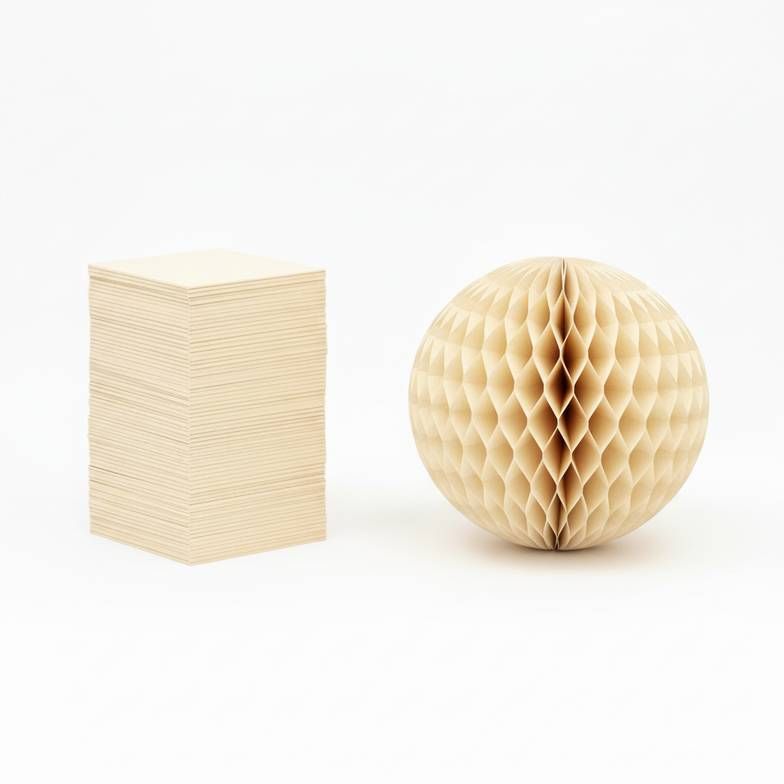
The full lifecycle has a massive effect on whether honeycomb paper decorations are sustainable. Their core design advantage is the ability to fold completely flat, which drastically reduces shipping volume and the associated logistics costs and carbon footprint compared to rigid displays. This efficiency, combined with thoughtful packaging and reusability, is a critical factor every buyer should evaluate.
Dive Deeper: Thinking Beyond the Product Itself
A product’s journey from the factory to the store and its eventual disposal is just as important as what it’s made of. For honeycomb decorations, the lifecycle advantages are clear and quantifiable.
The Unseen Advantage: Shipping Volume and Efficiency
This is the hidden genius of honeycomb paper structures. Their ability to ship flat is a game-changer for both cost and carbon footprint.
Let's use an example. Imagine you need a 1.5-meter-tall decorative Christmas tree for a store window display.
- A rigid, pre-assembled version would require a massive crate, taking up significant space in a shipping container. You might only fit a few dozen in a container.
- A foldable honeycomb paper version ships in a flat box that might be just a few centimeters thick. You could potentially fit thousands in the same container.
When I discuss this with logistics managers, they immediately grasp the benefit. We're not just talking about saving a few dollars; we're talking about a 90% or greater reduction in shipping volume. This directly translates to fewer containers, lower fuel consumption, and a dramatically smaller carbon footprint per unit. This is a sustainability win you can take straight to the bank.
Packaging: A Balancing Act of Protection vs. Waste
How the product is packed matters. The packaging needs to protect the delicate paper structure during transit, but it shouldn't be excessive. When evaluating a supplier, ask about their packaging options:
- Can individual polybags be replaced with paper sleeves or glassine envelopes?
- Is the master carton sized appropriately to maximize units and minimize empty space (which reduces shipping costs and waste)?
- Can you use cartons made from recycled content?
- Is the packaging designed for easy unpacking and potential repacking for store rollouts?
These operational details add up. Streamlined packaging means less waste for your distribution center or retail staff to manage.
End-of-Life: The Reality of "Recyclable"
"Recyclable" and "biodegradable" are two of the most misused terms in the industry.
- Recyclability: While the paper itself is recyclable, a finished honeycomb decoration with glue, magnets, and maybe a string is a "mixed material" product. Its acceptance in municipal recycling programs varies wildly by location. Most curbside programs are not equipped to handle them.
- Biodegradability: Paper is biodegradable, but under what conditions? In an industrial composting facility, it will break down relatively quickly. In a landfill deprived of oxygen, it will degrade very slowly.
Because of this complexity, we guide clients to prioritize reusability. Designing a product to be used 5, 10, or 20 times is a far more reliable and impactful sustainability strategy than hoping it gets recycled correctly at the end of its life. Be clear and honest about end-of-life options and avoid making promises to your customers that can't be universally kept.
Frequently Asked Questions
What is FSC certification and why does it matter?
The Forest Stewardship Council (FSC) is a global non-profit that promotes responsible forest management. An FSC certificate verifies that the paper used in a product comes from forests managed to meet high environmental and social standards. For buyers, it matters because it provides a credible, third-party verification of a supplier's material sourcing claims.
Are magnetic closures better than adhesive tape for sustainability?
For any decoration intended for more than a single use, yes. Magnetic closures allow the product to be easily opened, collapsed, and stored for future seasons. This focus on reusability extends the product's functional life, which is a core tenet of sustainability and provides a better return on investment for multi-year display programs.
What's more important: recycled content or FSC-certified virgin fiber?
Neither is universally "better"; they serve different sustainability goals. Using recycled content diverts waste from landfills and reduces the demand for virgin resources. Using FSC-certified virgin fiber ensures that new materials come from responsibly managed forests. The best choice depends on your brand's specific goals, product quality needs (virgin fiber often yields brighter whites), and marketing story.
How can I avoid "greenwashing" when sourcing paper decorations?
The best way to avoid greenwashing is to replace vague marketing terms with requests for specific, verifiable evidence. Don't accept "eco-friendly." Instead, ask: "What is your FSC certificate number?" "Can you provide a third-party test report for REACH compliance?" "Do you use water-based adhesives?" A transparent, credible supplier will welcome these questions and provide documentation.
Conclusion
Ultimately, asking "are honeycomb paper decorations sustainable?" is the beginning of the conversation, not the end. A professional buyer's real task is to build a specific sourcing checklist to evaluate any supplier. This means moving beyond marketing claims and asking for verifiable proof. It involves verifying material sources with active certificates, matching the product's construction—like paper weight and magnetic closures—to its intended lifecycle, and analyzing the huge efficiency gains from their foldable design. By asking these targeted questions, you can de-risk your procurement process and make an informed sourcing decision that truly aligns with both your commercial goals and your company's sustainability commitments.
If you're looking for a manufacturing partner who can help you navigate these questions and develop a thoughtful collection of honeycomb paper decorations for your next season, contact us at Mypaperbloom. We're ready to discuss your project specifications.